

Key facts: Moisture behind siding
Hidden moisture: the short answer
Moisture behind siding: the short answer
Water gets behind siding mostly at openings and intersections: window heads and sills, roof-to-wall joints, porch ledgers and the bottom of the wall. If the barrier and flashing behind are missing or damaged, it soaks the sheathing. Fixing it means finding and flashing the entry point, then repairing what got wet.
Moisture clues
Signs of moisture behind siding
| Clue | Likely source | Next step |
|---|---|---|
| Streaks below a window | Missing head flashing or failed sill | Have the window detail opened |
| Stripe of rot below a porch roof | Missing kick-out flashing | Add flashing and repair the wall |
| Soft bottom courses | Snow, soil or splashback | Restore clearance and repair |
| Peeling interior paint on an outside wall | Wet wall cavity | Call promptly |
| Musty closet on an outside wall | Long-term dampness | Have the wall opened |
Moisture figure
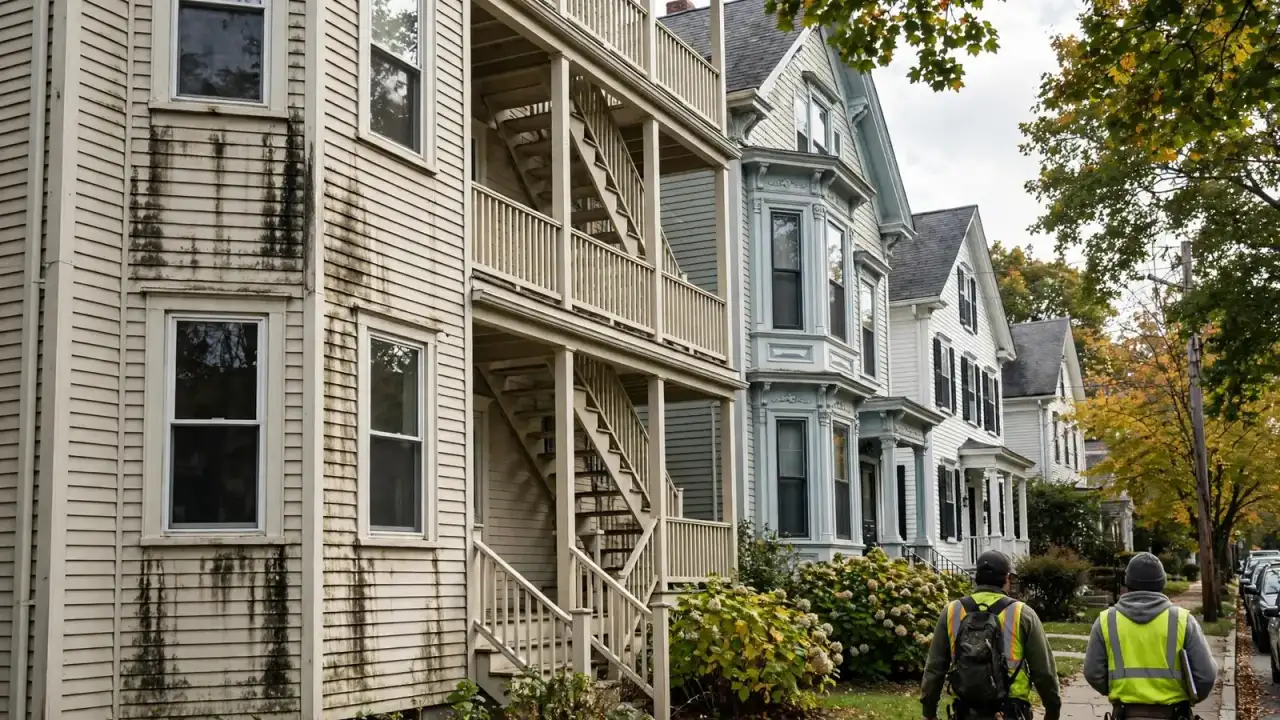
Moisture checks from the ground
Moisture checks you can do safely
- Look for streaks, stains and mildew below windows and porch roofs.
- Press on wood at the bottom of walls for softness.
- Check whether gutters overflow onto the wall.
- Look inside for stains, peeling paint or musty smells on outside walls.
- Check that downspouts discharge away from the foundation.
Windows and doors
Windows and doors as entry points
Many Boston houses have replacement windows installed without new head flashing or sill pans. Water runs down the face of the siding, gets behind the trim and soaks the wall below. The fix is to open the trim, add the missing flashing and repair the damaged wood.
Roof and porch intersections
Where roofs and porches meet walls
Porch roofs on triple-deckers send water down walls unless kick-out flashing diverts it into the gutter. Porch ledgers attached without flashing trap water against the house. Both cause long stripes of rot that are often hidden behind siding.
Inside moisture
Moisture from inside the house
In Boston's long heating season, warm moist air from kitchens, baths and laundry can travel into wall cavities and condense on cold sheathing. Good ventilation, air sealing and, when re-siding, exterior insulation reduce that risk.
How contractors trace moisture
How a contractor finds and fixes the leak
- 1
Trace the pattern
They map stains and soft spots to find the highest point of damage.
- 2
Open the wall
Siding is removed above and around the damage.
- 3
Find the entry
They identify the missing or failed flashing or barrier.
- 4
Repair
Rotted sheathing is replaced and the wall dried.
- 5
Flash and close
Proper flashing is installed and siding replaced.
Patch or rebuild after moisture
Repairing after moisture damage or replacing the wall
Moisture damage in one location is repaired once the source is fixed. Moisture in many locations suggests the barrier is failing across the house, which often makes re-siding the better route.
Boston moisture hot spots
Where moisture problems show up on Boston houses
Triple-deckers have stacked porches front and back, and every porch floor and roof meets the wall at a joint that can leak. Those joints are among the most common moisture sources in the city. Bay windows add many corners and small roofs, each with its own flashing. Flat roofs with parapets on some three-families send water down walls at scuppers and downspouts.
Older single-family houses have their own hot spots: the bottom of walls where soil has built up over the years, window sills where paint has failed, and dormers where roof and wall meet. Rowhouses in Charlestown and South Boston often have narrow back walls with little sun, where moisture lingers.
Old layers and trapped moisture
How old siding layers trap moisture
Original clapboard over board sheathing could dry outward because nothing sealed it in. When asbestos shingles, aluminum or vinyl went over it, sometimes with felt or foil in between, the wall lost some of that ability. Moisture from small leaks or from inside the house now has fewer ways out. When a contractor removes those layers, they often find damp, stained boards in spots that never showed a problem from the outside.
Mold and health
Mold, moisture and indoor air
Damp building materials can grow mold within a day or two if conditions are right, and mold inside walls can affect indoor air. The fix is always to stop the water first, then remove or clean affected materials and dry the wall. If you see mold on interior walls, mention it on your call so the contractor checks both sides.
Keeping walls dry
Preventing moisture problems
- Keep gutters clean and secure.
- Maintain clearances between siding and soil, decks and roofs.
- Re-seal trim joints each spring.
- Run bath and kitchen fans.
What to tell the contractor about moisture
What to mention about moisture when you call
- Where you see stains inside and out.
- Whether it is worse after storms or in winter.
- Any recent window or roof work.
- Whether anyone has noticed musty smells or mold inside.
Moisture and new windows
New windows and moisture behind siding
Window replacement without siding removal is common in Boston, and it is a frequent source of hidden leaks. Insert windows sit inside the old frame and rely on the old flashing, if any exists. Full-frame replacements remove the old frame and need new flashing integrated with the barrier, which is hard to do without removing some siding. Ask how the window installer handles flashing, or coordinate window and siding work together.
Moisture questions
Questions about moisture behind siding
Can siding itself stop water?
Not completely. Siding sheds most water, but some always gets behind it. The barrier and flashing behind are what keep the wall dry.
Is mold behind siding dangerous?
Mold on building materials can affect indoor air and indicates ongoing moisture. Fix the moisture source and remove damaged materials.
How do I know if water is getting in at my windows?
Look for stains or soft wood below the window outside and peeling paint or stains under the sill inside, especially after wind-driven rain.
Do ice dams cause moisture behind siding?
Yes. Meltwater backs up under the roof edge and can run down behind the top of the siding.
Will re-siding solve moisture problems?
If the job includes a new barrier, proper flashing and repairs to damaged sheathing, it removes the most common causes.
Can I caulk the siding to stop the water?
Caulk helps at specific trim joints, but sealing siding laps or bottom edges traps water that would otherwise drain. The real fix is flashing at the entry point.
How fast does water behind siding cause rot?
It depends on how wet the wood stays. Wood that stays damp for long periods can begin to decay within a season or two.