Key facts: Charlestown
- Charlestown was largely rebuilt after it was burned during the 1775 Battle of Bunker Hill, and much of its housing dates from the nineteenth century [1].
- In 2022 the Boston Landmarks Commission accepted a petition to study a Monument Square Landmark District in Charlestown [2].
- Boston's coastal resilience planning includes Charlestown as a neighborhood vulnerable to coastal flooding [3].
- Siding replacement in Charlestown requires a Short-Form permit, and landmark districts need Landmarks Commission approval [4].
Charlestown coverage
Charlestown areas covered
The contractor network accepts calls from Charlestown's ZIP code. Coverage can change, so call to confirm.
- 02129: all of Charlestown, including Monument Square, Town Hill, the streets around Bunker Hill, City Square, the Navy Yard area and the neighborhoods near Sullivan Square.
Charlestown housing
What Charlestown's houses are like
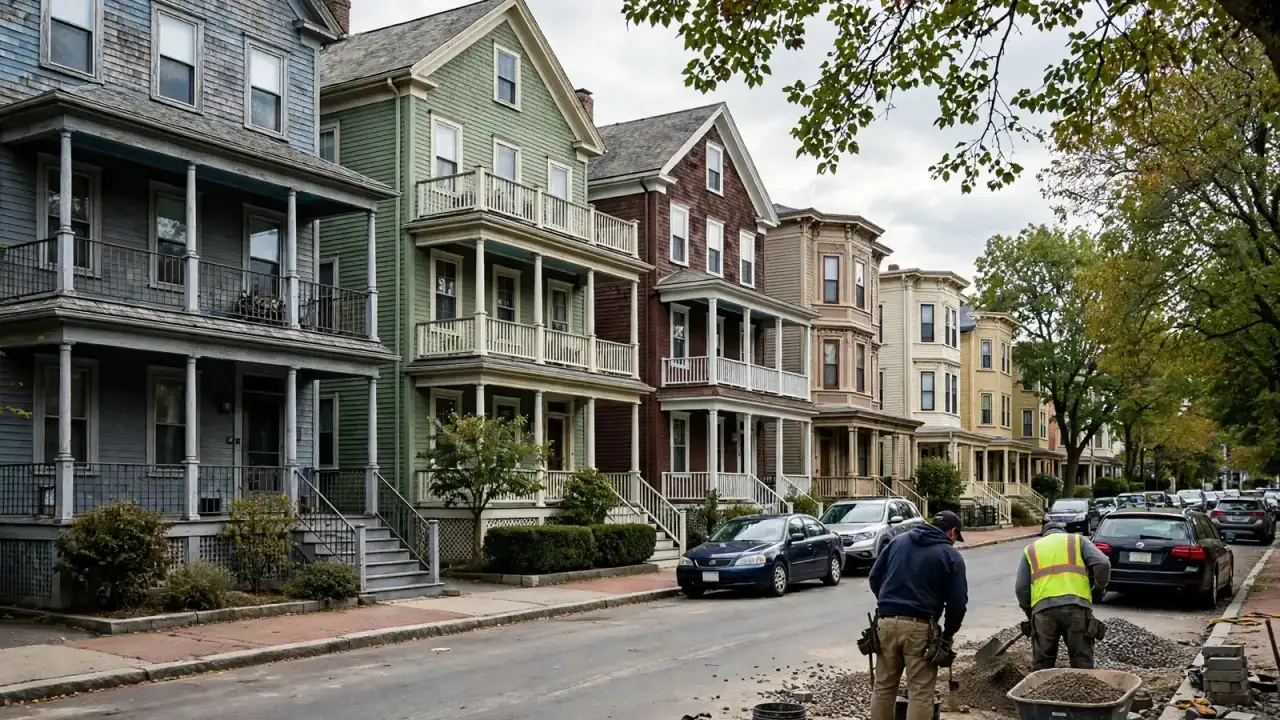
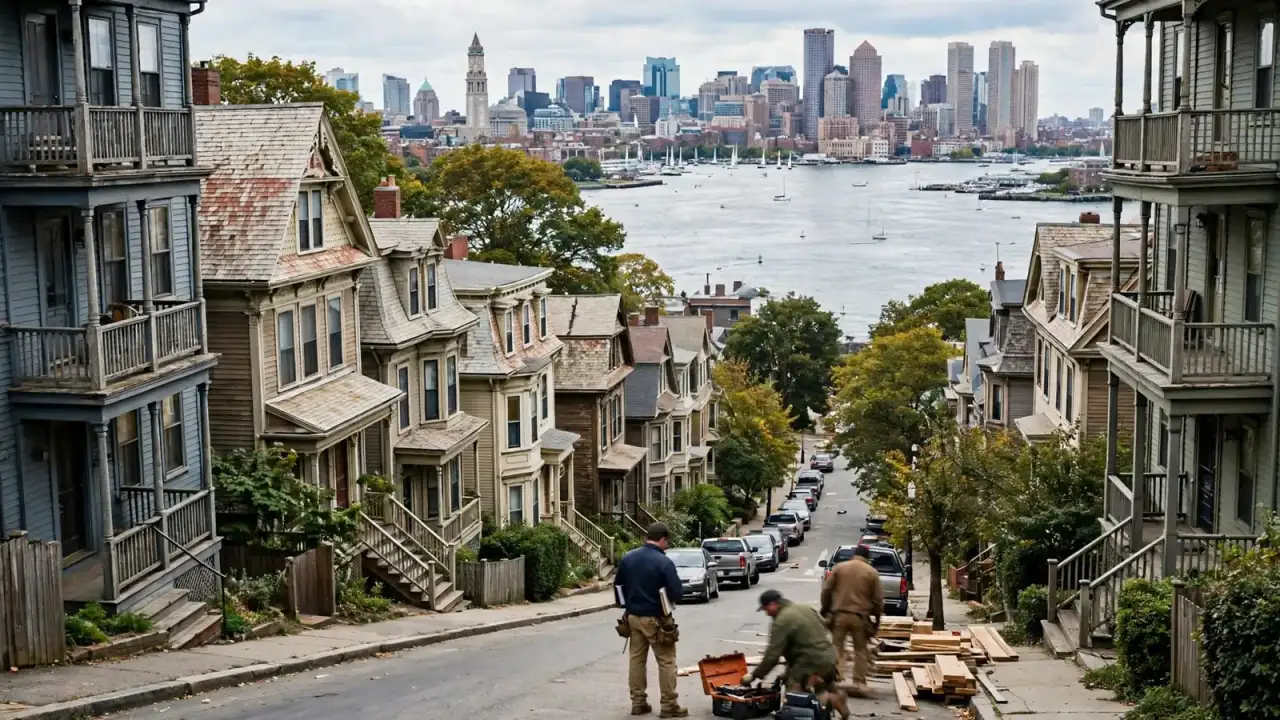
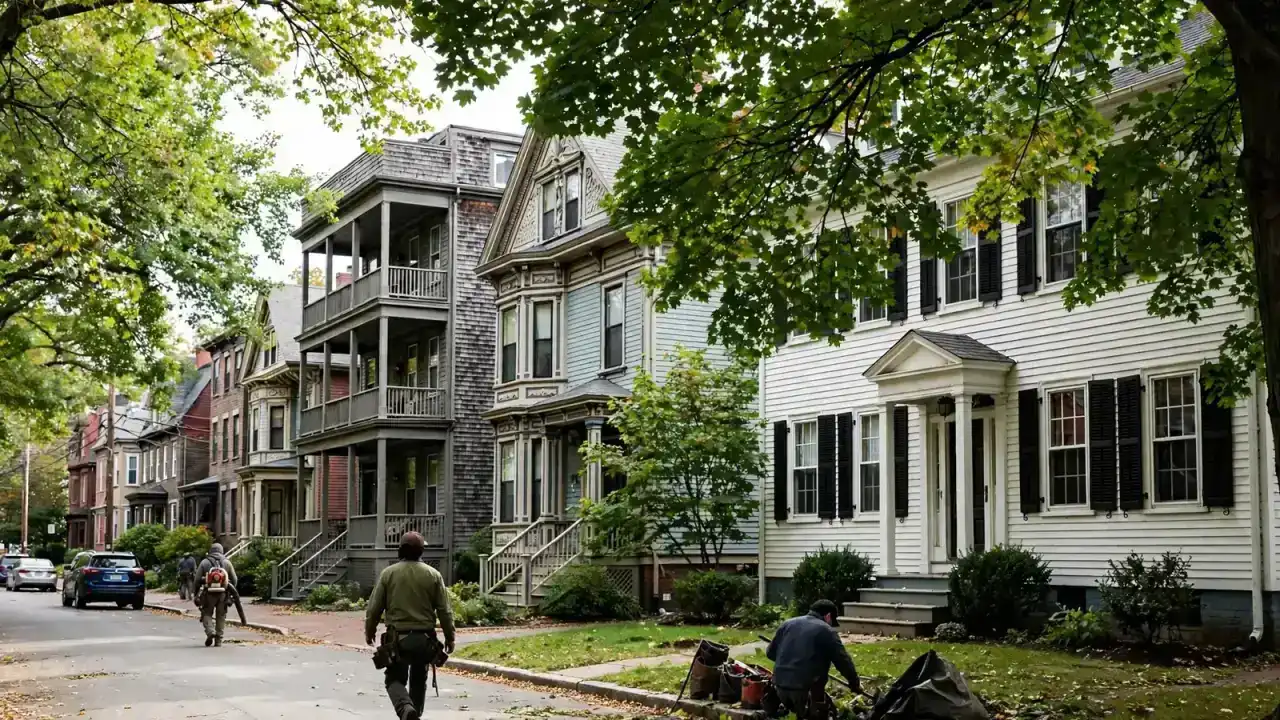
Charlestown was settled in 1629, before Boston itself, and was burned during the Battle of Bunker Hill in 1775. Most of what stands today was built in the decades that followed, through the nineteenth century. The result is one of the most intact historic neighborhoods in the city: Federal and Greek Revival rowhouses in brick and wood, Victorian houses on the slopes, and narrow streets that climb steeply toward the Bunker Hill Monument.
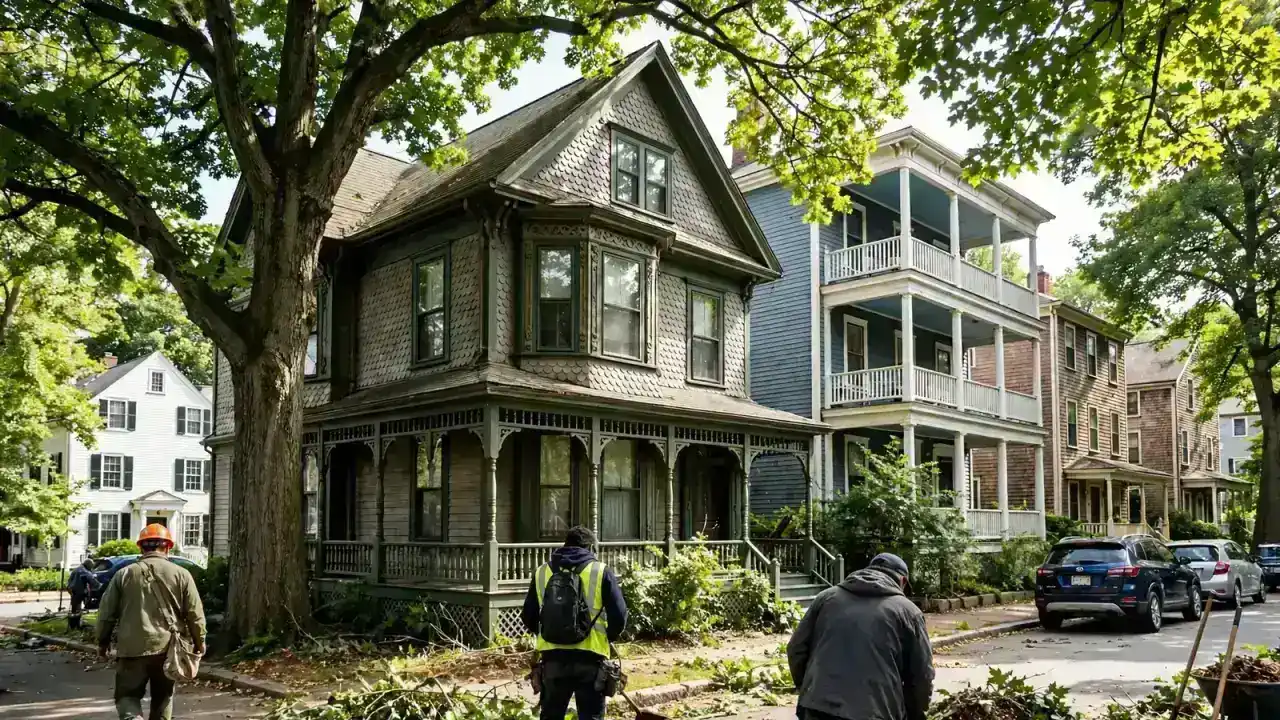
Wood-frame houses in Charlestown are often attached or nearly attached, with clapboard fronts facing the street, brick party walls and small rear yards. Many have simple, elegant trim typical of the Federal and Greek Revival periods: flat corner boards, cornices, pedimented doorways and six-over-six windows. Some have been covered with later siding, while many have been carefully restored.
Clapboard here is often narrow in exposure and hand-planed on the oldest houses. Matching it during repairs takes care, and many owners prefer wood or materials that look very close to wood.
Common Charlestown siding problems
Siding problems contractors see in Charlestown
These problems come up most often on Charlestown houses.
Paint failure on clapboard fronts
Street-facing clapboard takes weather and needs regular painting; neglected walls peel and rot.
Read moreRot at sills and cornices
Window sills, door surrounds and cornices have exposed end grain that rots first.
Read moreRear wall neglect
Rear walls and additions get less attention and often carry layered or failing siding.
Read moreJoints with brick neighbors
Where wood houses meet brick party walls, flashing and sealant joints fail.
Read more
Historic character in Charlestown
Siding work and Charlestown's historic character
Much of Charlestown's appeal comes from its historic streetscape, and owners tend to value original materials. The Boston Landmarks Commission accepted a petition in 2022 to study a Monument Square Landmark District around the Bunker Hill Monument. [2] If a district is designated, visible exterior changes within it will need commission review. Some properties in Charlestown are already individual landmarks.
Even outside any designation, many owners choose to repair rather than replace historic clapboard, or to replace it with wood or fiber cement that matches the original exposure and profile. Vinyl is less common on Charlestown fronts than in other neighborhoods, though it appears on rear walls and some later houses.
Before choosing materials, check whether your property has a designation or sits within a study area. Your contractor can help, and the Landmarks Commission staff can confirm.
Charlestown clapboard figure
Clapboard repair in Charlestown
Repairing and matching historic clapboard
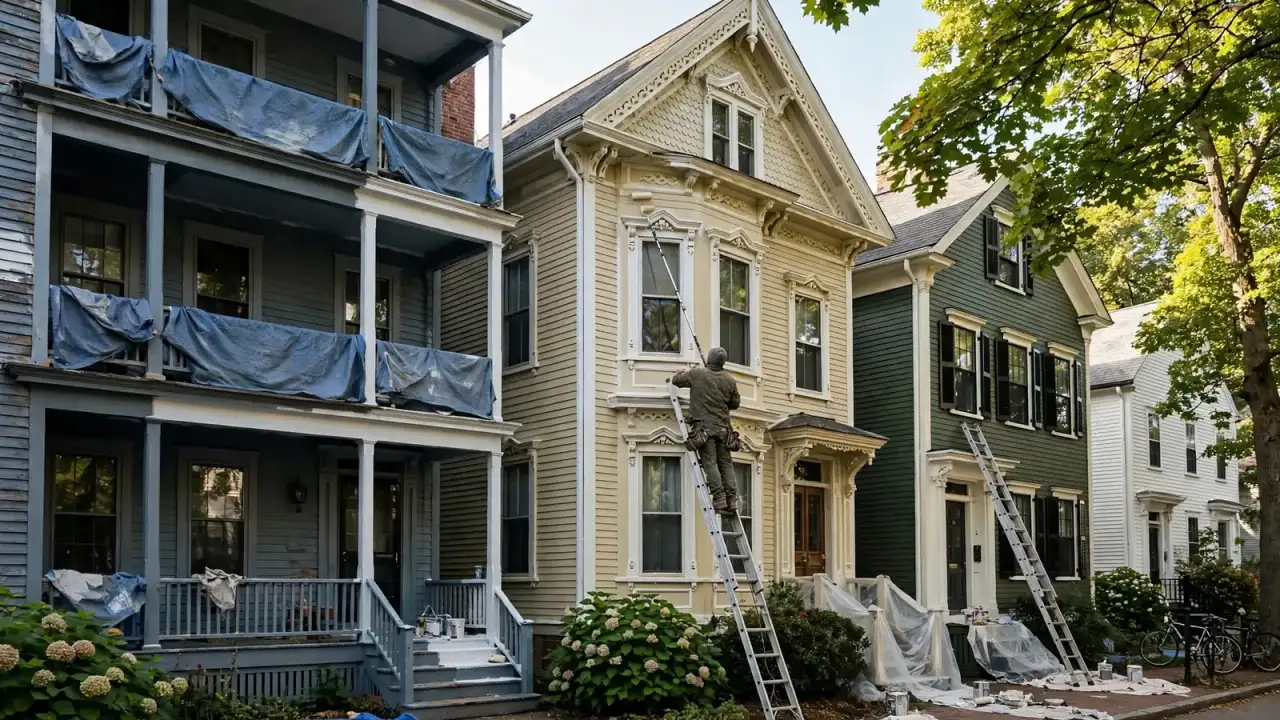
Repairing old clapboard means removing only the damaged boards, which are often at the bottom of the wall, below windows and at corners. New boards should match the exposure, thickness and profile of the old ones. For the narrowest historic clapboard, boards may need to be milled to match. Splices are staggered and backed by the sheathing, end joints are sealed and boards are primed on all sides before installation.
Paint is the clapboard's protection. Scraping and repainting a Charlestown facade every several years keeps it sound. On pre-1978 houses, paint preparation must follow lead-safe practices, which means containment, careful scraping and cleanup. [5] Many repair projects combine board replacement with a full repaint.
Tight lots and steep streets in Charlestown
Access on Charlestown's steep, narrow streets
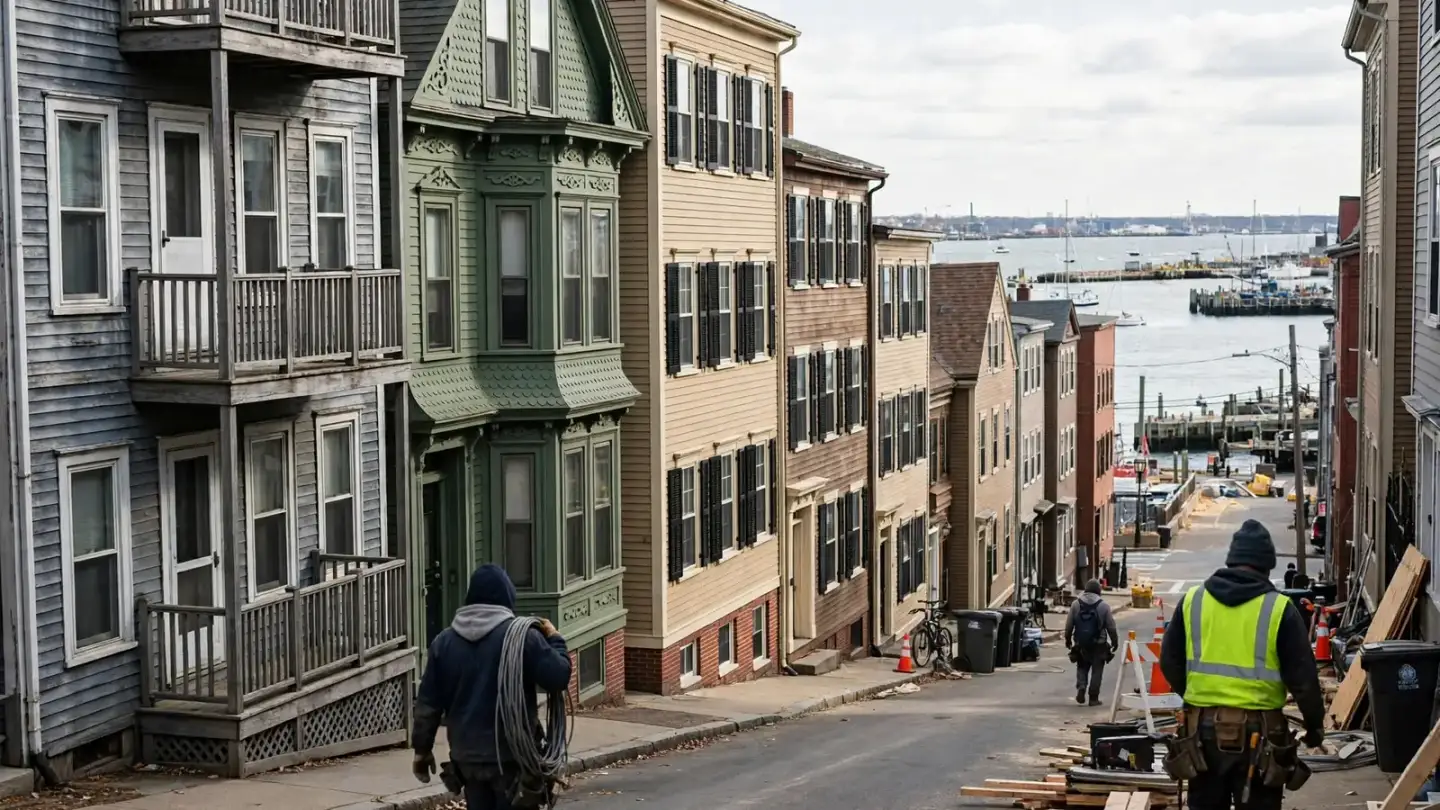
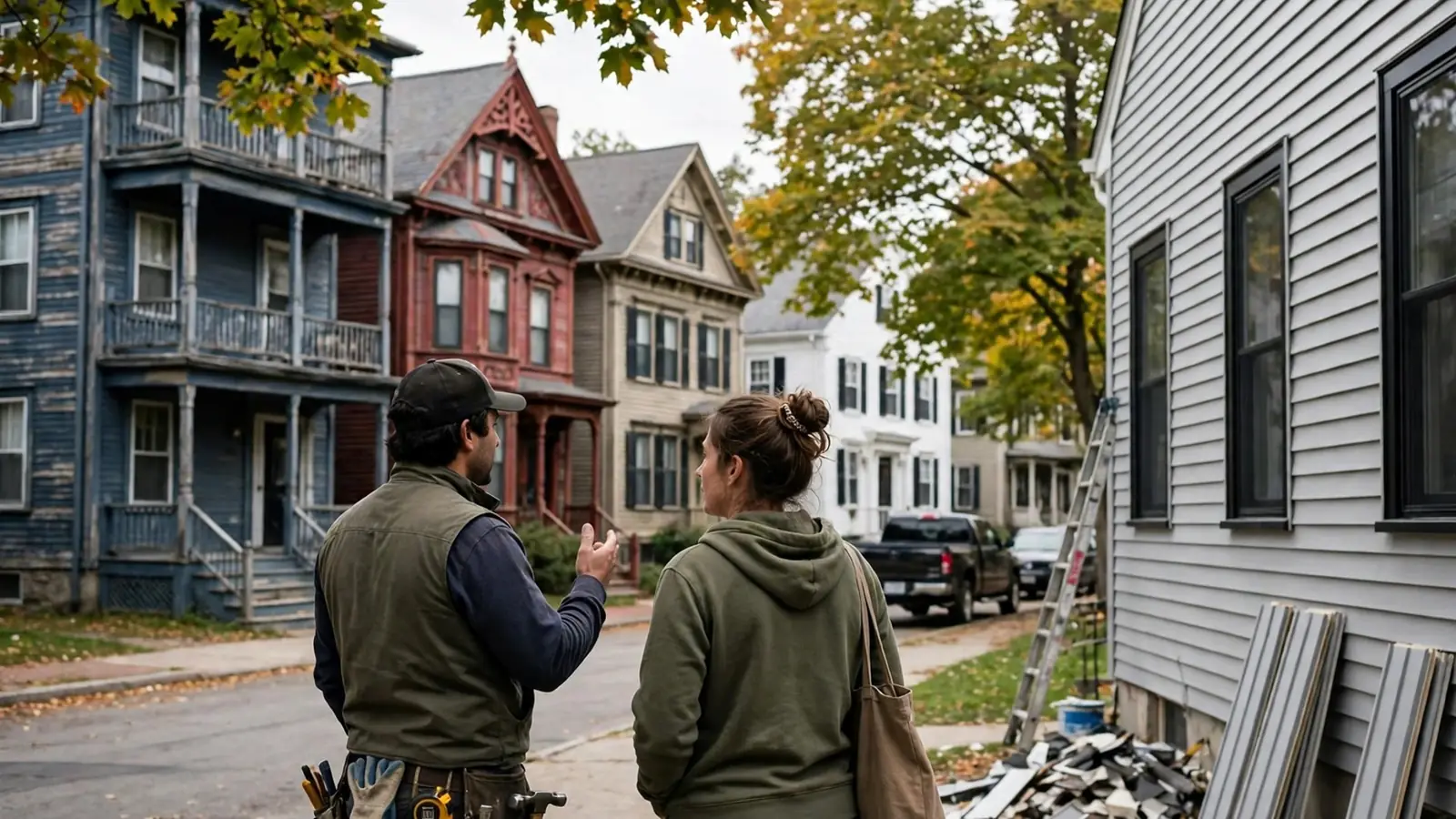
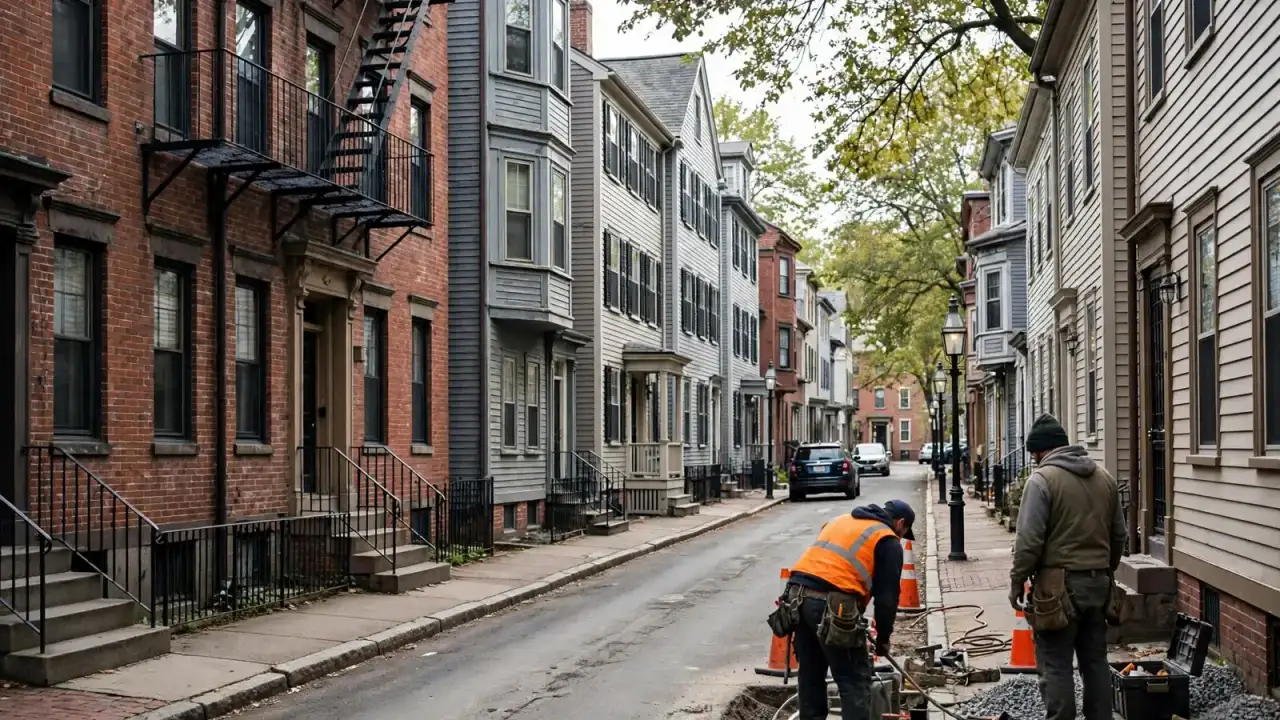
Charlestown's streets are narrow, steep and parked full. Many houses sit right at the sidewalk, with no side yard and a tiny rear yard reached through the house. Staging on the front means using the sidewalk, which requires a city permit for sidewalk or street occupancy. Rear walls may be reachable only through the house, from a neighbor's yard or from the roof.
Contractors used to Charlestown plan for these constraints: smaller staging, materials carried by hand, careful protection of neighbors' property and scheduling around parking rules. Ask how they will reach each wall before agreeing to the scope.
Wood and brick in Charlestown
Where wood houses meet brick neighbors
Charlestown mixes wood and brick houses on the same block. Where a wood house abuts a brick party wall, the joint between clapboard and masonry is a weak point. Sealant there dries and cracks, and water runs into the wood wall. A good repair adds metal flashing or a trim detail that sheds water away from the joint, rather than relying on caulk alone.
Coastal exposure in Charlestown
Harbor wind and flooding in Charlestown
Charlestown sits on a peninsula between the Mystic and Charles Rivers, facing the harbor. The Navy Yard and waterfront streets face salt air and coastal storms. Boston's coastal resilience planning identifies low-lying parts of Charlestown, including areas near Sullivan Square and the waterfront, as vulnerable to flooding. Houses on the hill sit above that risk but catch wind. Corrosion-resistant fasteners and careful flashing help near the water.
Lead paint in Charlestown
Lead-safe practices on Charlestown houses
Almost every Charlestown house predates 1978, and the oldest have generations of paint layers. Paid work disturbing that paint must follow EPA lead-safe practices. On narrow streets with children walking by, containment on the sidewalk and careful cleanup matter.
Permits in Charlestown
Permits and approvals for Charlestown siding work
Charlestown is part of the City of Boston, so siding replacement needs a Short-Form permit from Inspectional Services. [4] If your property is a landmark or within a designated district, visible changes need Landmarks Commission approval first. Staging on sidewalks or streets requires an occupancy permit. Charlestown borders Somerville and Everett across the water and highways; those cities have their own building departments.
Planning a Charlestown visit
Planning a siding visit in Charlestown
- 1
Historic status
Check whether your property has a landmark designation or is in a study area.
- 2
Sidewalk staging
Ask who obtains the sidewalk or street occupancy permit.
- 3
Rear access
Note how the crew can reach the rear wall.
- 4
Neighbors
Talk to neighbors about staging, dust protection and access near party walls, and agree on how the joint between your houses will be finished.
- 5
Matching
Keep a sample of original clapboard for matching.
- 6
Photos
Photograph the front, rear and any visible side walls, plus close-ups of rotted sills, cornices and joints with neighboring buildings.
- 7
Timing
Exterior painting needs mild weather, so plan repainting for spring through early fall.
Charlestown house types
Charlestown house types and siding notes
| House type | Where common | Siding notes |
|---|---|---|
| Federal and Greek Revival wood rowhouse | Town Hill, Monument Square area | Narrow clapboard, historic trim, repair focus |
| Victorian wood house | Slopes of Bunker Hill | Shingles, decorative trim |
| Brick rowhouse with wood rear | Throughout | Wood rear walls and bays |
| Later two-family | Near Sullivan Square | Vinyl or fiber cement re-sides |
| Navy Yard conversions | Navy Yard | Mostly masonry; limited siding |
Choosing materials in Charlestown
Siding materials that suit Charlestown houses
Wood clapboard remains the traditional choice for Charlestown fronts and is often expected on historic houses. Fiber cement with a narrow smooth reveal can come close to the look of painted wood with less upkeep, and may suit rear walls or less sensitive houses. Vinyl is generally used only on rear walls or later houses. PVC trim can replicate simple Federal-style trim while resisting rot.
Charlestown sections up close
Siding notes for Charlestown's sections
- Monument Square and Town HillThe historic core around the monument, with Federal and Greek Revival houses and the highest sensitivity to historic character.
- Bunker Hill slopesSteep streets with mixed wood and brick rowhouses and Victorians.
- City Square and waterfrontOlder streets near the harbor, salt air and wind.
- Sullivan Square areaLater houses and two-families near highways, with flood exposure in low areas.
- Navy YardMostly masonry buildings converted to residences, with limited siding work.
Cornices and doorways in Charlestown
Cornices, doorways and Federal trim
Charlestown's houses have restrained but important trim: wide cornices at the roofline, flat corner boards and pedimented or columned doorways. These elements have horizontal surfaces and end grain where water collects. Repairs involve replacing rotted sections with matching wood or PVC, adding cap flashing where possible without changing appearance and repainting. A contractor experienced with historic houses will preserve profiles carefully.
Rear walls in Charlestown
Rear walls and additions in Charlestown
Behind the polished fronts, many Charlestown houses have rear ells, additions and decks added over two centuries. Rear walls often carry later siding, sometimes in poor condition. Re-siding a rear wall with fiber cement or even vinyl can be practical, since it is less visible. Flashing at decks, roofs and doors is as important here as anywhere.
Timing Charlestown work
When to schedule siding work in Charlestown
Spring through fall suits exterior painting and clapboard repair best, since paint needs moderate temperatures. Winter work is possible for repairs, with painting delayed. Allow time for any Landmarks review and sidewalk permits.
Paint versus replacement in Charlestown
Repainting historic clapboard or replacing it
For many Charlestown houses, the best siding project is a careful repaint with selective board replacement rather than new siding. Original clapboard made from old-growth wood is often more durable than new wood, and it carries the house's character. If most boards are sound, scraping, priming and repainting under lead-safe practices keeps the original wall in service for years more.
Replacement makes sense when boards are rotted across large areas, split badly or covered by layers that cannot be removed without destroying them. In those cases, new wood clapboard milled to match or fiber cement with a narrow smooth reveal can restore the look. The choice depends on condition, historic status and how much upkeep you want.
Federal-period details
Features of Federal and Greek Revival houses
Federal houses from the early nineteenth century tend to have simple, flat facades with narrow clapboard, thin corner boards, delicate cornices and fanlights or transoms over doors. Greek Revival houses that followed have heavier cornices, wider corner boards shaped like pilasters and doorways with columns or pilasters and entablatures. Keeping these proportions when repairing or replacing siding matters. A contractor who understands them will match board exposure, keep trim widths and avoid adding modern details that look out of place.
Bays and dormers in Charlestown
Bays, dormers and roof joints on Charlestown houses
Many Charlestown houses gained dormers, bays and roof decks over the years. Dormers set into steep roofs create cheek walls and roof-to-wall joints that leak when flashing fails. Roof decks add railings, posts and doors through the roof. Water from these elements often ends up behind clapboard. When repairing siding near them, contractors check step flashing, counterflashing and the deck connections.
Neighbors and party walls
Working beside Charlestown neighbors
On streets where houses share walls or touch, siding work affects neighbors. Staging may need to stand in front of a neighbor's door. Scraping and painting must be contained so dust does not reach next door. The joint where your clapboard meets their wall needs a detail both houses can live with. Talk to neighbors early and ask the contractor how they will protect adjacent properties and coordinate access.
Sidewalk staging in Charlestown
Staging and sidewalk permits in Charlestown
Because most Charlestown houses meet the sidewalk, front-wall work usually requires staging on the sidewalk and sometimes a dumpster in the street. The city requires permits for sidewalk and street occupancy, and pedestrians must be able to pass safely. Contractors used to working here plan covered walkways or narrow staging, schedule deliveries around parking restrictions and keep the sidewalk clear at the end of each day.
Moisture on Charlestown slopes
Water flowing down Charlestown's hills
On Charlestown's steep streets, rainwater runs fast along sidewalks and gutters, and houses on the downhill side of a block may have soil or pavement sloping toward their walls. Splashback wets the lowest clapboards, and rear yards below grade may collect water against the foundation. Restoring clearance between siding and grade, adding a drip edge above the foundation and directing downspouts away from walls help keep the bottom of the wall dry.
Choosing a Charlestown contractor
Questions to ask a contractor working in Charlestown
Ask whether they have worked on Federal or Greek Revival houses and how they match narrow historic clapboard. Ask how they handle lead-safe preparation, sidewalk staging permits and protection of neighbors' homes. Ask whether they will check your property's landmark status and help with any Landmarks Commission application. Check their Massachusetts Home Improvement Contractor registration and get the scope and materials in writing.
Charlestown winters
Winter on Charlestown's clapboard
Winter winds sweep across Charlestown's hill from the harbor and the Mystic River. Narrow streets channel snow and slush against the base of houses, and ice forms on stoops and sidewalks beside the walls. Salt used on sidewalks splashes onto the lowest clapboards and trim. Keeping paint in good condition at the base of the wall, and rinsing salt residue in spring, protect the wood.
Restoring later-covered houses
Removing later siding from a Charlestown house
Some Charlestown houses were covered with asbestos-cement shingles, aluminum or vinyl in the mid-twentieth century. Removing those layers can reveal original clapboard and trim, sometimes in surprisingly good condition, sometimes heavily damaged. Asbestos-cement shingles must be removed by a licensed abatement contractor. Aluminum and vinyl can be removed by the siding crew, but the clapboard beneath carries old paint, so lead-safe practices apply.
Once the original wall is exposed, the contractor and owner decide what to keep. Sound clapboard can be repaired and painted. Missing trim can be rebuilt using evidence such as paint lines and nail holes. Where the original is beyond repair, new wood or fiber cement can replace it. These projects are slower than a standard re-side but can transform a house's appearance.
Insulation in historic Charlestown walls
Insulating historic walls in Charlestown
Adding exterior insulation to a historic Charlestown house is often not desirable, because it changes the relationship between clapboard, trim and windows that defines the facade. Owners who want warmer rooms usually insulate from the inside, air-seal around windows and doors, and add storm windows. On rear walls and later additions, exterior insulation during re-siding may be acceptable. Ask the contractor what fits your house and any historic review.
Charlestown storm checks
Checking a Charlestown house after a storm
After a storm, look at the cornice, the tops of bays and dormers and the joints with neighboring buildings, where wind-driven rain and loosened trim show up first. Check rear walls and roof decks from your yard or deck. Photograph damage and call before the next storm. On historic fronts, ask for repairs that match existing boards and trim rather than quick patches.
Charlestown siding questions
Questions about siding in Charlestown
Is my Charlestown house in a historic district?
The Landmarks Commission accepted a petition in 2022 to study a Monument Square Landmark District, and some properties are individual landmarks. Check your property's status before choosing materials.
What should I tell the contractor about my Charlestown house?
Its age and style, whether it is attached, any landmark status you know of, which walls have problems and how the rear can be reached. Photos help.
Can vinyl siding go on a Charlestown house?
On rear walls and later houses, often yes. On historic fronts, many owners choose wood or fiber cement, and any designated district would need review.
How is old clapboard matched?
New boards are chosen or milled to match the exposure, thickness and profile of the old ones, then primed and painted to blend in.
Do I need a permit for sidewalk staging?
Yes. Staging or dumpsters on sidewalks or streets need an occupancy permit from the city.
Do I need a permit for siding in Charlestown?
Yes. Siding replacement needs a Short-Form permit from Boston's Inspectional Services Department, plus Landmarks approval where applicable.
Why does the joint with my brick neighbor leak?
Caulk between clapboard and brick fails over time. A flashing or trim detail that sheds water is more durable.
How do contractors handle lead paint on old clapboard?
Firms paid to disturb paint on pre-1978 homes follow EPA lead-safe practices, including containment, careful scraping and cleanup.
Should I repaint or replace my Charlestown clapboard?
If most boards are sound, repairing and repainting keeps original material and character. If rot is widespread, replacement with matching wood or fiber cement may be better.
Will my neighbors be affected by siding work?
Often yes, on attached streets. Staging, dust and access can affect neighbors. Talk with them early and ask the contractor how they will protect adjacent homes.
How do I check a contractor's registration?
Ask for their Massachusetts Home Improvement Contractor registration and check it on the state's Contractor Hub.