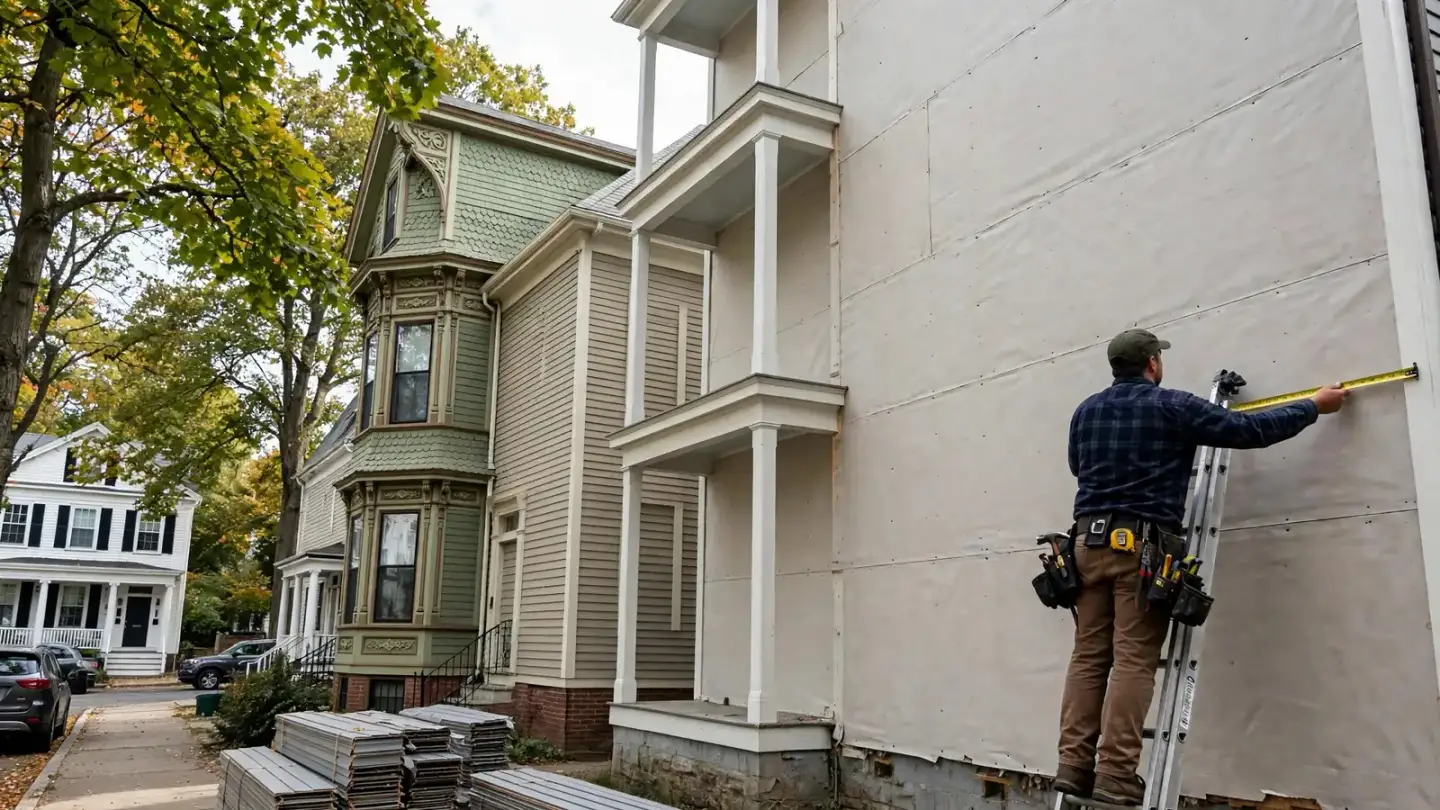
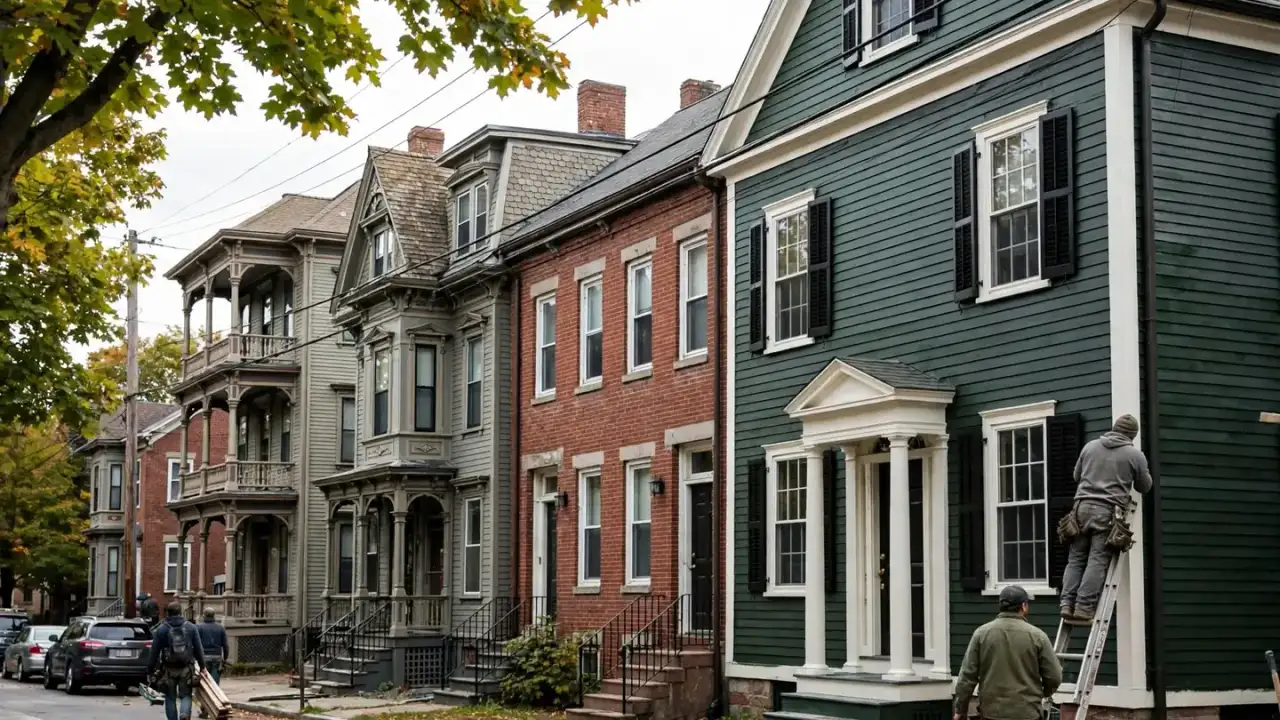
Key facts: Fiber Cement Siding
- Fiber cement siding is made from cement, sand and cellulose fibers, which makes it noncombustible and resistant to rot and insects [1].
- Cutting fiber cement can release respirable crystalline silica, and OSHA sets work practices to control that dust [2].
- Manufacturers specify clearances above roofs, decks and grade so fiber cement boards do not sit in water [3].
- Boston requires a Short-Form building permit for siding replacement, and its historic districts add Landmarks Commission review [4].
How fiber cement works
What fiber cement siding is and how it behaves
Fiber cement is a composite board made mostly of cement and sand, reinforced with cellulose fibers. It is pressed into planks, panels and shingles that look like painted wood but do not rot, burn or attract insects. Boards come either primed for field painting or with a factory-applied finish.
Unlike vinyl, fiber cement does not move much with temperature, so it is nailed snug to the wall. It does absorb some water, though, which is why manufacturers insist on primed or painted surfaces, sealed cut edges and clearances from the ground, roofs and decks. Most of the long-term problems with fiber cement come from ignoring those details.
Its weight changes how a job runs. Planks are heavy and can snap if carried flat, so crews carry them on edge and often work in pairs. On a three-story house, staging and material handling take more planning than with vinyl. The payoff is a wall that resists dents and hail, holds paint far longer than wood and gives a solid, traditional look.
Fiber cement trim is available, though many installers pair fiber cement siding with PVC or wood trim. The trim choice affects how joints are detailed and how the house looks up close, so it is worth discussing early.
Fiber cement trouble signs
Signs fiber cement siding needs attention
Fiber cement is durable, but these issues show up when installation details were skipped.
Swollen or crumbling bottom edges
Boards that sit too close to soil, roofs or decks soak up water and break down at the edge.
Open butt joints
Gaps between plank ends without flashing behind them let water reach the sheathing.
Read morePeeling paint at cut ends
Unsealed cut edges absorb water and push paint off.
Cracks near nails
Nails driven too close to edges or overdriven can crack boards.
Bowing or uneven planks
Uneven framing or wet boards installed in a hurry can leave wavy lines.
Damage after impact
Fiber cement resists hail well, but a hard enough strike can still crack it.
Read more
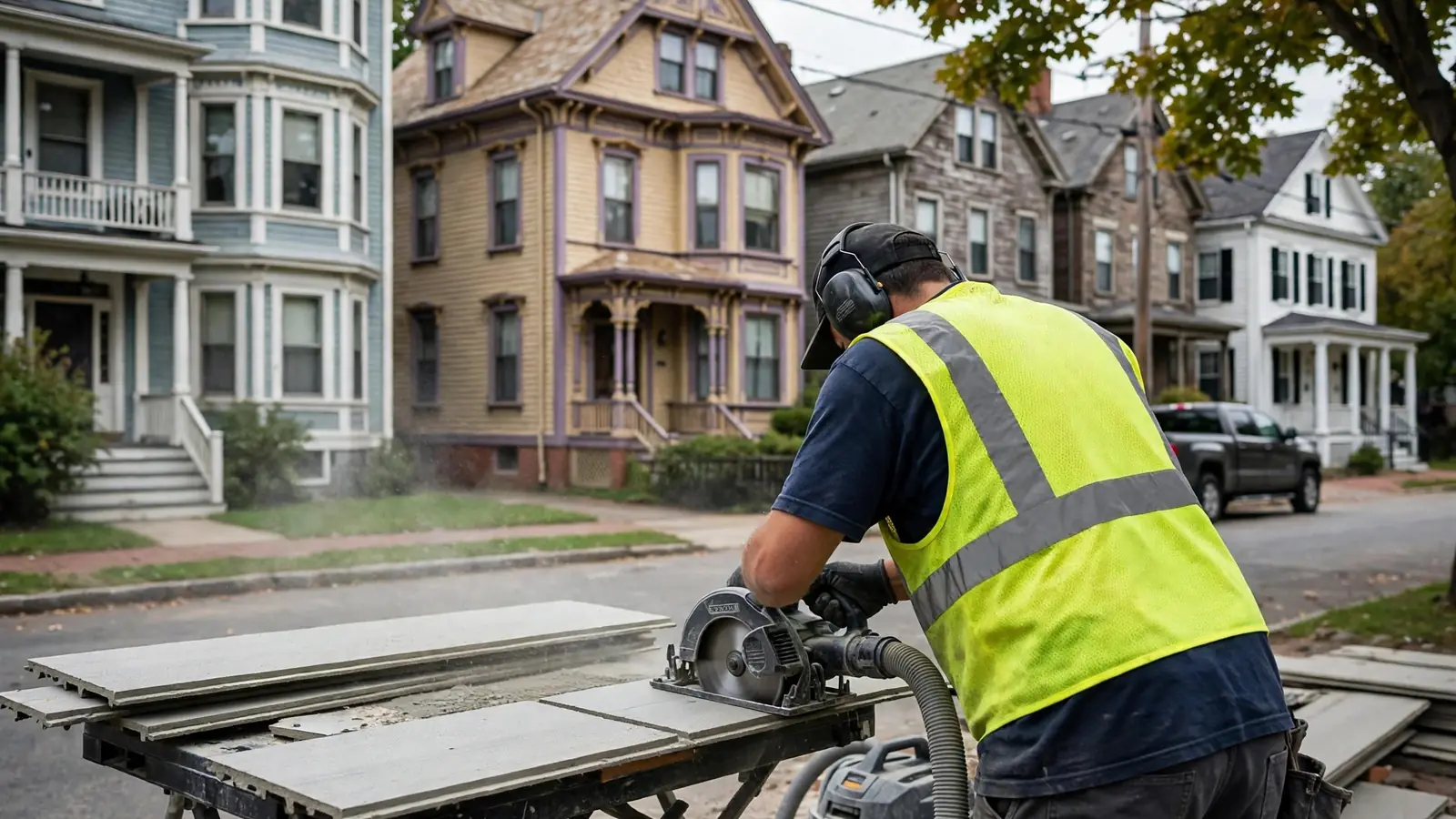
Fiber cement cutting
Why fiber cement fails
Why some fiber cement jobs go wrong
When fiber cement fails, the cause is almost always one of a few details. Boards installed tight to the ground, a deck or a roof surface wick up water. Butt joints without a flashing strip behind them leak. Cut edges left unpainted absorb moisture. Nails placed too close to the ends crack the board. Each of these is spelled out in manufacturers' instructions, and each one is easy to skip under time pressure.
Paint is the second weak point. Field-painted boards need good primer coverage and a quality topcoat. Factory finishes last longer but still need touch-up at cuts and nail heads. In Boston, sun on south walls and freeze-thaw on north walls wear paint at different rates.
Framing matters too. Fiber cement does not hide uneven walls as well as vinyl. On old Boston houses with wavy framing, a contractor may need to shim or replace sheathing to get straight lines.
Fiber cement install steps
How fiber cement siding is installed
- 1
Assess and plan
The crew checks the walls for flatness, decides on trim material and confirms clearances at grade, roofs and decks.
- 2
Prepare the wall
Old siding is removed under lead-safe practices on older homes, sheathing is repaired and housewrap is lapped properly. [5]
- 3
Flash openings
Windows and doors are flashed, and kick-out flashing is placed wherever roofs meet walls.
- 4
Set trim and starter
Corner boards, window trim and a starter strip are installed so the first course angles correctly.
- 5
Cut with dust control
Boards are cut outdoors with shears or saws fitted with dust collection, and cut ends are sealed.
- 6
Install the planks
Planks are blind-nailed or face-nailed as specified, with joints over studs and flashing behind butt joints.
- 7
Paint and finish
Primed boards are painted, factory-finished boards get touch-up, and joints are caulked where instructions call for it.
Fiber cement products
Fiber cement products for Boston homes
| Product | Look | Typical use |
|---|---|---|
| Lap planks (smooth or wood grain) | Painted clapboard | Colonials, triple-deckers, capes |
| Shingle panels or individual shingles | Painted or stained shingles | Victorians, shingle-style houses, gables |
| Vertical panels with battens | Board and batten | Additions, garages, modern renovations |
| Fiber cement trim | Square-edged painted trim | Corners and windows where a matching material is wanted |
| Factory-finished boards | Baked-on color | Owners who want longer intervals between painting |
Fiber cement owner checks
Fiber cement checks you can do yourself
Do these from the ground once or twice a year.
- Look at the bottom edge of the lowest courses for swelling, flaking or soft spots.
- Check where siding meets porch roofs and decks for a visible gap above the surface.
- Scan for open joints between plank ends or between siding and trim.
- Note any spots where paint is peeling, especially at cut ends and corners.
- Keep gutters clear so overflow does not soak one wall.
- Never cut or sand fiber cement without proper dust control.
Fiber cement stop point
Why fiber cement cutting belongs with the pros
Cutting fiber cement creates fine dust that can contain respirable crystalline silica, which can damage the lungs. [2] Professional crews use shears, dust-collecting saws or wet methods to control it. Homeowners without that equipment should not cut fiber cement. The boards are also heavy and awkward on ladders. Replacing a cracked board up high is a contractor job.
Fiber cement siding in Boston: local specifics
Fiber cement on Boston houses
Fiber cement has become popular on Boston's colonials and Victorians because it delivers the painted-wood look that suits older neighborhoods, without the rot and frequent repainting of wood. For owners of houses in Jamaica Plain, West Roxbury or Roslindale who want to keep a traditional appearance, it is often the first material they ask about.
In historic districts, it may or may not be accepted. The Boston Landmarks Commission reviews visible exterior changes, and some districts expect original materials to be repaired or replaced in kind. Fiber cement can come closer to wood than vinyl does, but approval depends on the district and the house. Always check before ordering material.
Most houses being re-sided in Boston were built before 1978, so removing old painted clapboard falls under federal lead-safe work practices for paid contractors. That adds containment and cleanup steps to the tear-off. On top of that, fiber cement cutting brings silica dust controls. Crews used to both will run the job cleanly.
Re-siding with fiber cement needs the same Short-Form permit from Boston's Inspectional Services Department as any siding replacement. [4] In Cambridge, Somerville and Quincy, permits go through each city's own building department.
Weight and access are practical concerns on tight Boston lots. Material often needs to be staged on the sidewalk or driveway and carried to the work area, and a street occupancy permit may be needed for a dumpster. A contractor who works in the city regularly will plan for this.
Fiber cement repair or replace
Repairing fiber cement versus re-siding
| Condition | Repair approach | When re-siding is better |
|---|---|---|
| A few cracked planks | Cut out and replace, flash joints | Rarely needed |
| Swelling at the bottom course | Replace affected boards and restore clearance | If the whole perimeter is affected |
| Open joints without flashing | Add flashing and seal where allowed | If most joints are missing flashing |
| Peeling paint | Prep and repaint | Not needed unless boards are damaged |
| Wet sheathing behind | Fix the leak and repair | If damage spreads across walls |
Fiber cement paint care
Painting and caring for fiber cement in Boston weather
Fiber cement holds paint far better than wood because it does not swell and shrink with moisture in the same way. Even so, Boston's mix of strong summer sun and long wet winters wears paint unevenly. South and west walls fade faster. North walls stay damp longer and may grow mildew.
Factory-finished boards carry a baked-on coating that lasts many years. Field-painted boards should be primed on all sides before installation where possible and finished with a high-quality exterior acrylic. Cut edges and nail heads need sealing or touch-up. When repainting, wash gently, let the boards dry, and touch up joints first.
Fiber cement and fire
Fire resistance and close-together houses
Because fiber cement is noncombustible, many owners choose it for houses that sit very close to their neighbors, as so many Boston triple-deckers and rowhouses do. Building codes include requirements for exterior walls near property lines, and a noncombustible cladding can simplify compliance in some cases. A contractor familiar with Boston's code requirements can tell you whether spacing affects your material choice.
Fire resistance also matters for porches and fire escapes, which are common on three-family houses. Using a noncombustible siding near those areas adds a margin of safety.
Fiber cement on Victorians
Fiber cement shingles on Victorian details
Victorian houses in Jamaica Plain, Dorchester and Roxbury often mix clapboard on lower floors with decorative shingles on gables and upper stories. Fiber cement shingle panels and individual shingles can reproduce those patterns. Some are cut to match fish-scale or diamond shapes. Trim around decorative windows and brackets usually stays in wood or PVC, because fiber cement trim works best with simple profiles.
Combining materials takes careful detailing at transitions. Where shingle panels meet lap siding, flashing and trim boards need to direct water outward. A contractor experienced with older houses will plan those transitions before ordering.
Fiber cement joints and flashing
Butt joints, flashing strips and caulk on fiber cement
Joints are where fiber cement either succeeds or fails. Lap planks come in fixed lengths, so long walls need butt joints where two plank ends meet. Those joints are not watertight on their own. Manufacturers call for a strip of flashing behind each butt joint, or a joint that lands on a trim piece, so water that gets in is sent back out over the plank below. Skipping that strip is one of the most common shortcuts seen on failing walls.
Where planks meet trim at corners and windows, instructions usually call for a small gap filled with a paintable sealant, though some systems rely on flashing rather than caulk. Over-caulking is its own problem: sealing the bottom edge of a plank, for example, traps water that would otherwise drain out. A contractor who knows the system will caulk where the instructions say and leave drainage paths open everywhere else.
Window heads need a metal drip cap or a flashing tape detail, and horizontal trim boards such as band boards between floors need a cap flashing so water does not sit on their top edge. On Victorians and three-family houses with many horizontal trim lines, those small flashings add up to a significant part of the job.
Clearances complete the picture. Fiber cement should stop a set distance above the soil, above paved surfaces such as walkways and decks, and above roof surfaces where a wall continues above a porch roof. The exact distances are set by the manufacturer. On older Boston houses, where grade has crept up over a century and decks sit close to door thresholds, achieving those clearances sometimes means lowering soil, adjusting a deck or adding a metal transition at the bottom of the wall.
Fiber cement on triple-deckers
Using fiber cement on three-family houses
Fiber cement is less common than vinyl on Boston's triple-deckers, but it is gaining ground among owners who want a painted look without the constant upkeep of wood. A full fiber cement re-side of a three-family house is a big project. The weight of the boards means more trips up the staging, and painting three stories of field-primed boards adds time unless factory-finished boards are used.
Bays and porches need careful planning. Narrow strips of fiber cement around bay windows and between porch posts must still follow the clearance and joint rules, and cutting many small pieces creates more dust to manage. Some owners choose fiber cement for the flat walls and PVC for intricate trim and bays, which speeds the job and keeps the look consistent from the street.
Tenants and neighbors need a plan for dust and noise. Crews cut fiber cement with dust-collecting tools, but staging near open windows, porches and shared driveways still calls for coordination. Ask the contractor where cutting will happen and how debris will be handled each day.
Fiber cement and other trades
Coordinating fiber cement siding with roofing, windows and gutters
Because fiber cement must clear roof surfaces by a set distance, siding work often overlaps with roofing. Where a porch roof meets a wall, the step flashing and kick-out flashing should be in place before the siding goes on. If the roof is due for replacement soon, it often makes sense to do the roof first or coordinate both trades so the flashing is integrated.
New windows are best installed before fiber cement so they can be flashed into the new barrier. Gutters go up after siding and trim, but their outlets and downspouts should be planned so water does not discharge against the base of a fiber cement wall. A contractor who manages these sequences reduces the chance of trades undoing each other's work.
Fiber cement compared with wood
How fiber cement compares with traditional wood clapboard
For owners of older Boston houses, the real comparison is often fiber cement versus new wood clapboard. Wood is the original material, it is easy to cut and repair with ordinary tools, and in historic districts it may be the expected choice. Its weakness is water: wood needs paint maintained, end grain sealed and clearances respected, or it rots. On a three-story house, keeping paint in good shape on every wall is a recurring job.
Fiber cement trades some of wood's workability for durability. It does not rot or attract insects, and paint lasts longer on it. It is heavier and needs dust-controlled cutting, and repairs require matching boards rather than a simple wood splice. Both materials look best with good trim and careful joint details.
Many owners choose by asking how long they plan to stay and how much upkeep they want to take on. If the house is in a historic district, the Landmarks Commission may make the choice for visible walls.
Fiber cement warranties
Warranties and paperwork for fiber cement installs
Fiber cement manufacturers offer product warranties that depend on following their installation instructions, including clearances, joint treatment, fastening and finishing. Factory finishes usually carry their own coverage. Because those warranties can be voided by installation shortcuts, it is worth asking your contractor which instructions they follow and keeping a copy with your house records. Keep the product name, color and lot information in case you need matching boards for future repairs.
Fiber cement siding questions
Questions about fiber cement siding in Boston
Is fiber cement siding good for Boston winters?
Yes. It does not get brittle in cold like vinyl, resists impact and does not rot. Its weak spots are bottom edges and joints, so clearances and flashing must follow the manufacturer's instructions.
Does fiber cement need to be painted?
Either it comes with a factory finish or it is primed and painted on site. Both need touch-up at cuts and nail heads. Paint lasts much longer on fiber cement than on wood.
Is cutting fiber cement dangerous?
The dust can contain crystalline silica, which can harm the lungs. Contractors use dust-controlled saws, shears or wet methods to follow OSHA rules. Homeowners should not cut it without the right equipment.
Can fiber cement replace wood clapboard in a historic district?
Sometimes. The Boston Landmarks Commission reviews visible changes, and some districts prefer repair in kind. Ask the contractor to check your district before choosing fiber cement.
Is fiber cement heavier than vinyl?
Much heavier. Crews carry planks on edge and plan staging carefully, especially on three-story houses. The weight is part of why it feels solid and resists wind.
Can fiber cement be installed over old siding?
Manufacturers usually require a flat, solid base. On older Boston homes, removing old layers is normally recommended so the wall can be inspected and flashed.
What maintenance does fiber cement need?
Keep gutters working, keep clearances clear, wash off dirt gently, inspect joints and repaint or touch up as the finish wears.
Do I need a permit for fiber cement siding in Boston?
Yes. Siding replacement needs a Short-Form permit from Inspectional Services, and historic districts require Landmarks Commission approval for visible changes.
Can a single cracked fiber cement board be replaced?
Yes. A contractor cuts or pulls the fasteners, slides out the damaged plank, installs a new one with flashing behind its joints and paints it to match. Matching factory colors is easiest when the product name is known.
Does fiber cement attract termites or carpenter ants?
No. Insects cannot eat fiber cement. They can still damage wet wood framing behind it, so keeping walls dry and flashing in good shape remains important.
Will fiber cement siding crack in a hard freeze?
Properly installed and painted fiber cement handles freezing well. Problems come from boards that stay wet, such as those touching soil or roofs, where repeated freezing can break down edges.
Can fiber cement siding be installed on a wavy old wall?
It can, but the wall usually needs work first. Crews shim low spots, replace damaged sheathing and check framing so the planks run straight, because fiber cement shows unevenness more than vinyl does.