Key facts: Vinyl Siding
- Vinyl siding should be fastened with nails centered in the slots and left slightly loose so each panel can slide as temperatures change [1].
- ASTM D3679 is the product standard for rigid PVC siding, covering properties such as impact resistance and dimensional stability [2].
- Re-siding a Boston home with vinyl still requires a Short-Form permit from the city [3].
- Vinyl siding is a rain screen, so it relies on a water-resistive barrier and flashing behind it to keep walls dry [4].
How vinyl siding works
How vinyl siding protects a wall
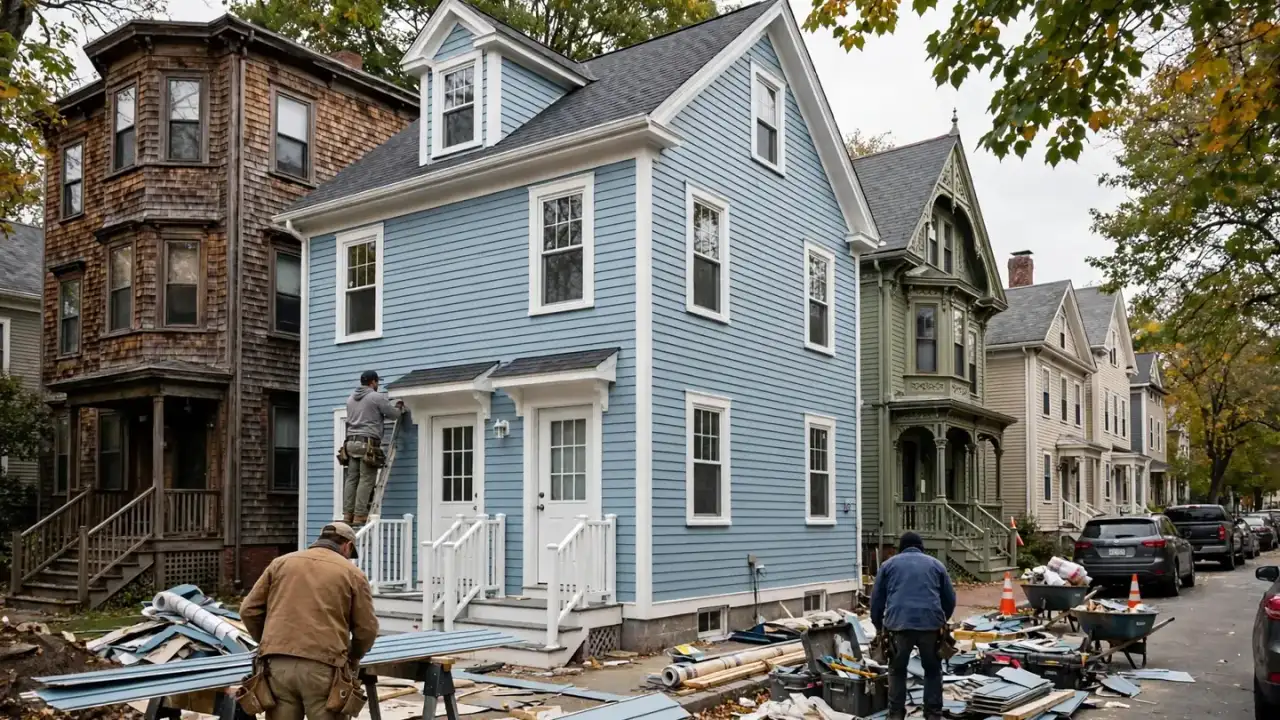
Vinyl siding is made from rigid PVC, extruded into long panels that lock together at the top and bottom. Each panel hangs from nails driven through slotted holes along its top edge. The bottom of the panel locks into the top of the one below, so the whole wall becomes a set of overlapping horizontal pieces that shed rain.
What surprises many homeowners is that vinyl is not designed to be watertight. The panels are loose on purpose, the joints between panel ends overlap rather than seal, and small weep holes at the bottom let water out. The wall behind is protected by the housewrap and flashing, while the vinyl takes the sun, wind and most of the rain. That design works well as long as the layers behind are done properly.
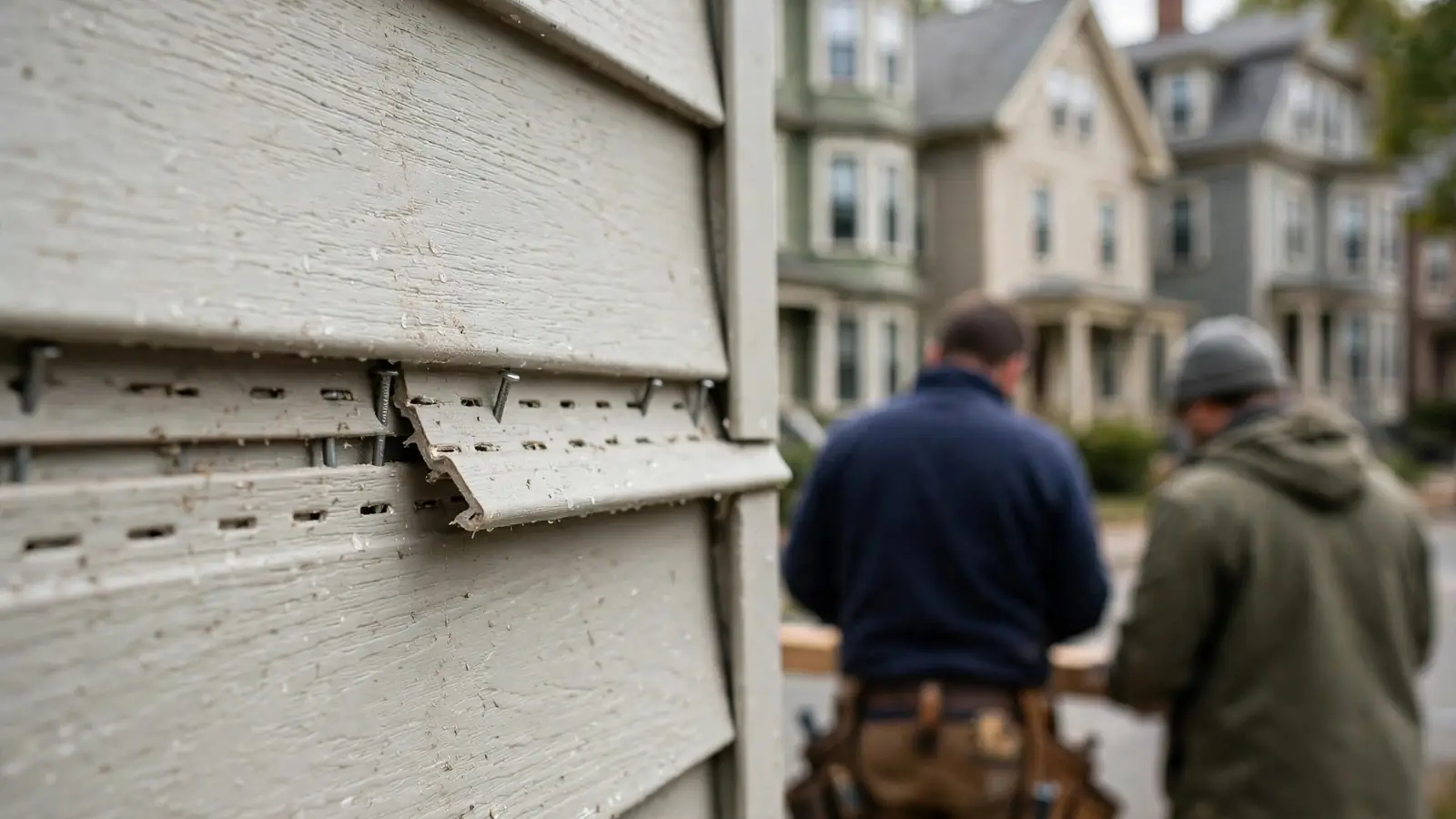
Vinyl expands and contracts more than wood. A long panel can change length noticeably between a cold winter night and a hot summer afternoon. That is why installation instructions call for nails left slightly loose, centered in the slots, with gaps at the ends of panels where they meet corner posts and J-channel. [1] A wall where every rule is followed will look flat and straight for decades. A wall nailed tight will ripple in summer and crack in winter.
Modern vinyl comes in many profiles and thicknesses. Thicker panels are stiffer and resist waves and dents better. Insulated vinyl adds a foam backing that makes panels more rigid and adds a modest layer of insulation. Colors have improved too, and darker colors that once faded or warped are now made with formulations meant to handle more heat.
Vinyl warning signs
Signs your vinyl siding needs attention
Vinyl fails in a handful of predictable ways. Most can be repaired if caught early.
Waves and ripples
Panels that bow outward in summer were usually nailed too tight. Re-hanging them fixes the look and prevents cracks.
Cracks and holes
Cold vinyl is brittle. A ladder bump, a thrown ball or hail can crack it, especially in January.
Read morePanels unlocked by wind
The bottom lock can pop free in a gust, leaving a panel bulging or flapping. Clip it back before the next storm.
Chalky, faded surface
Older vinyl loses pigment and gloss. It is cosmetic at first but often a sign the panels are getting brittle.
Read moreMelted or warped spots
Reflected sunlight from new windows next door, or a grill too close, can distort vinyl.
Water stains inside
If interior walls stain behind vinyl, the issue is flashing or barrier, not the panels.
Read more
Vinyl detail
Why vinyl fails
What makes vinyl siding fail early
Most early vinyl failures come from installation, not the material. Tight nailing is the classic mistake. Another is cutting panels too long so they jam against corner posts and J-channel with no room to expand. Panels that are face-nailed, or nailed at the end of the slot instead of the center, behave the same way.
Weather adds to it. In Boston, a panel might see near-zero temperatures in February and strong sun on a south wall in July. A panel that is pinned cannot follow those swings. Wind is the other stress. Nor'easter gusts pull at panels from below, and a weak lock or a panel without proper nailing support can unlock and blow off.
Older vinyl also ages. Ultraviolet light breaks down the surface over years, leaving it chalky and more brittle. Panels made decades ago were often thinner than what is common now. Once a wall reaches that stage, individual repairs become harder because the old panels crack when they are unlocked.
Vinyl install steps
How a contractor installs vinyl siding on an older house
- 1
Prepare the wall
Old siding comes off, sheathing is repaired and the wall is checked for flatness, since vinyl shows every bump beneath it.
- 2
Barrier and flashing
Housewrap is lapped shingle-style, and windows, doors and roof joints are flashed before any trim goes on.
- 3
Starter strip and corners
A level starter strip goes at the bottom, and corner posts and J-channel are set with expansion gaps.
- 4
Hang the panels
Panels are locked into the course below and nailed in the center of the slots, leaving a small gap under the nail head.
- 5
Overlap and stagger
Panel ends overlap in the direction that hides joints from the main view, and joints are staggered course to course.
- 6
Trim and finish
Utility trim under windows and at the top of walls holds the last course, and soffit and fascia are finished.
- 7
Final check
Each panel should slide by hand, lines should be level and every opening should be trimmed and flashed.
Vinyl profiles
Vinyl siding profiles and where they suit Boston houses
| Profile | Look | Typical Boston use |
|---|---|---|
| Traditional lap (double 4 or 5 inch) | Classic horizontal boards | Triple-deckers and two-families |
| Dutch lap | Lap with a shadow groove | Colonials and capes |
| Board and batten | Vertical boards with narrow battens | Gables, additions, accent walls |
| Shake or shingle panels | Cedar shingle look | Gables and bays on Victorians, shingle-style homes |
| Insulated lap | Thicker lap with foam backing | Drafty walls where exterior foam is not added |
| Beaded or clapboard-style single lap | Narrow traditional reveal | Older homes where a historic look matters |
Vinyl owner checks
Checks homeowners can make on vinyl siding
All of these can be done from the ground.
- Try sliding a lower panel side to side with your hand. Panels that will not move at all may be nailed tight.
- Look along each wall from the corner for waves, bulges or panels that have dropped out of their lock.
- Check that vinyl stops above the ground, mulch and deck surfaces, with room for water to drain.
- Look for melted spots near grills, dryer vents or across from reflective windows.
- Clean mildew with a soft brush and a mild cleaner. Avoid harsh pressure washing that drives water behind panels.
- Keep a few spare panels from the original job for future repairs.
Vinyl stop point
When to hand vinyl work to a contractor
Unlocking and relocking a panel is a simple skill, but most of the vinyl on Boston houses is above the first floor, and ladder work at those heights is risky. A cracked panel up high, a wavy wall that needs re-hanging or anything near a window is best handled by a contractor with staging.
Stop as well if you see staining behind a panel, rotted wood or mold. Those mean the vinyl is not the real problem, and the wall needs opening.
Vinyl siding in Boston: local specifics
Boston conditions that shape vinyl siding work
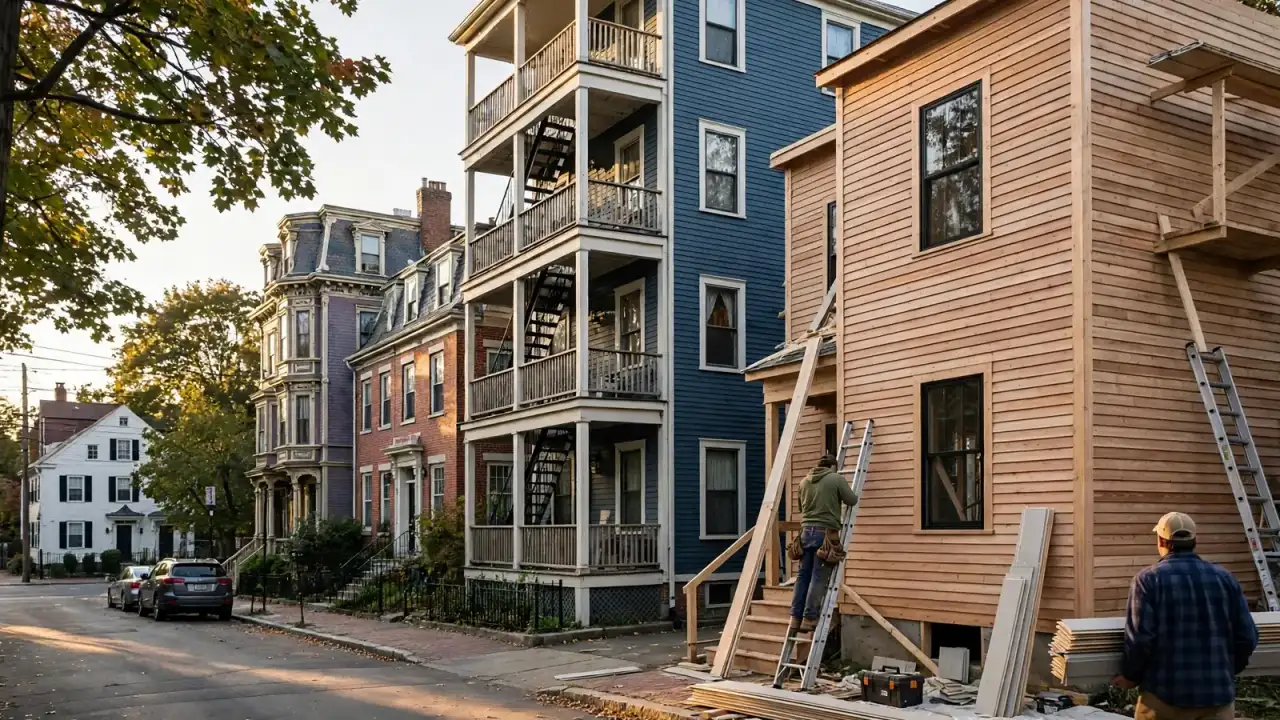
Vinyl is everywhere on Boston's triple-deckers. Many owners chose it because painting a three-story wood house is a large recurring job, and in neighborhoods like Dorchester, Roslindale and Hyde Park, rows of vinyl-clad triple-deckers are common. That makes vinyl a natural choice, but it also means many walls now carry vinyl that went up decades ago over older layers.
Winter is the key test. Cold vinyl cracks more easily when struck, so contractors working in winter handle panels carefully and avoid bending them. Snow piles against bottom courses for weeks, so the bottom of a wall needs good clearance and a sound starter strip. Ice dams at the eaves can push water behind the top courses if the roof edge and utility trim are not detailed properly.
Historic districts are the main restriction. In districts reviewed by the Boston Landmarks Commission, a change from wood to vinyl may not be approved for visible walls. Outside those districts, vinyl is widely used. Re-siding with vinyl still needs Boston's Short-Form permit, and nearby cities such as Cambridge and Somerville handle permits through their own offices. [3]
Fire separation is also worth asking about. Triple-deckers and rowhouses often sit very close to the next building, and building codes set requirements for exterior walls near property lines. A contractor familiar with Boston will know when a material choice is affected by that spacing.
Vinyl repair or replace
Repairing vinyl versus re-siding
| Condition | Repair | Re-side |
|---|---|---|
| A few cracked or blown-off panels | Yes, if matching panels exist | Only if panels are discontinued and badly faded |
| Wavy wall from tight nailing | Re-hang panels on that wall | If waves are everywhere and panels are distorted |
| Brittle panels that crack when unlocked | Difficult | Usually the better choice |
| Water damage behind | Repair after fixing the leak | If damage is widespread |
| Color badly faded and uneven | Not really fixable | Re-side or consider painting with a vinyl-safe color |
Vinyl color and matching
Matching color and profile on older vinyl
Matching is the hardest part of vinyl repair. Panels fade with sun exposure, so a north wall and a south wall on the same house may already be different shades. Manufacturers retire colors and profiles over time, and even the same named color from a different production period can look slightly different.
Contractors have a few tricks. They can borrow panels from an inconspicuous spot, such as behind a porch, and put new panels there. They can replace a whole wall section between corners so the change in color falls at a natural break. Some vinyl can be painted with special coatings formulated for vinyl, using colors that will not overheat the panel, though that becomes a maintenance item.
If you are re-siding, keep a box of spare panels and note the manufacturer and color. It makes future repairs far easier.
Vinyl and moisture
Vinyl siding and moisture in the walls
Because vinyl is loose and ventilated, it is generally forgiving about moisture. Water that gets behind panels can drain and dry. Problems arise when the barrier or flashing behind is missing, when vinyl was installed over old siding that traps water, or when soil or snow keeps the bottom of the wall wet. In those cases mold and rot can develop where no one sees them.
Insulated vinyl and contoured foam backers make walls stiffer and a little warmer, but they also change how water drains. Installation instructions for those products need to be followed closely, with drainage paths kept open.
Vinyl, soffits and gutters
Soffit, fascia and gutters with vinyl siding
A vinyl siding job usually includes the roof edge. Vented vinyl soffit lets air into the attic, which helps reduce ice dams when combined with proper insulation and roof vents. Aluminum fascia wrap covers the wooden fascia boards behind the gutters. If those boards are rotted, they should be replaced before being wrapped, otherwise the rot keeps spreading under the metal.
Gutters matter more than most people expect. A gutter that overflows above a vinyl wall pours water on the same panels every storm and can push water behind the top course. Contractors often recommend checking gutter pitch and downspouts at the same time.
Vinyl on triple-decker bays
Vinyl on bays, cornices and decorative trim
Bow and angled bays are a defining feature of Boston's triple-deckers, and they make vinyl jobs more complex. Each facet of a bay needs its own corner details, and curved bays require careful cutting so panels follow the curve without stress. Cornices and decorative brackets are often wrapped in aluminum coil or covered with vinyl trim. Some owners choose to restore the wood details instead, especially on homes with distinctive Victorian trim, and use vinyl only on the flat walls.
Choosing vinyl for a Boston house
How to choose a vinyl siding product
Vinyl products vary more than they look in a brochure. The main differences are panel thickness, the depth of the nailing hem, the profile and reveal, color technology and whether the panel has a foam backer. Thicker panels with a reinforced nailing hem hold up better to wind and stay straighter on long walls. A triple-decker's side walls can run more than thirty feet high with long horizontal runs, where a stiffer panel shows fewer waves.
Color choice affects performance. Darker colors absorb more heat, so products in deep colors are usually made with formulations designed for it. Lighter colors fade less noticeably over time. If your house is in full sun on a south or west wall, ask how the chosen color is expected to behave there.
Profile and reveal shape the character of the house. A narrow reveal reads as traditional clapboard and suits older houses. A wider reveal looks more modern. Many Boston owners choose a profile close to the original clapboard so the house still fits the street, especially on blocks of matching triple-deckers.
Ask your contractor to show you the manufacturer's installation instructions for the product they recommend and to explain the warranty terms, including how installation affects coverage.
Accessories that matter
Trim, corners and accessories in a vinyl siding job
The parts around the panels do much of the work. Outside and inside corner posts give panel ends a channel to expand into. J-channel frames windows, doors and the tops of walls. Utility trim holds cut panels under windows and at the soffit. Mounting blocks give lights, outlets and hose bibs a flat, flashed surface to sit on. Starter strip sets the first course straight and level.
Low-grade or missing accessories show up as gaps and leaks. Light fixtures screwed directly through vinyl, with no mounting block, crack the panel and let water in. J-channel over a window without a flashing kick at the corners dumps water into the wall. A thoughtful installer uses the right accessories for each penetration and integrates them with the flashing.
Wrapped window trim is a common vinyl-era detail in Boston. Aluminum coil stock bent around old wood casings protects them from weather but can trap water if not done well. When re-siding, consider whether the old wood trim behind needs repair or replacement before it is wrapped again, or whether PVC trim would be a better solution.
Cleaning vinyl
Cleaning and caring for vinyl siding
Vinyl needs little care, but a yearly wash keeps it looking good and lets you spot problems. A soft brush on an extension pole with a mild household cleaner and water removes dirt and most mildew. Rinse from the top down. Pressure washers can drive water up behind the panels and into the wall if aimed upward or held too close, so if you use one, keep it on a low setting and spray down and level, never up under the laps.
Shaded walls in leafy neighborhoods grow mildew and algae faster. Trimming shrubs and branches back from the wall lets it dry and slows regrowth. Avoid strong solvents, which can damage the surface. Keep grills and fire pits well away from vinyl walls, because heat can warp panels quickly.
While cleaning, look at each course for panels that have dropped out of their lock, nails that have backed out, and cracks near corners. Small problems found during a wash are easy to fix before winter.
Vinyl siding questions
Questions about vinyl siding in Boston
How long does vinyl siding last in Boston?
Well-installed vinyl can last decades. Lifespan depends on panel thickness, color, sun exposure and installation quality. Panels nailed too tight or installed over damaged walls tend to fail much sooner.
Can vinyl siding be installed in winter?
Yes, with care. Cold vinyl is more brittle, so installers handle panels gently and leave the correct expansion gaps for the temperature that day. Some details, such as sealants, may need warmer conditions.
Is thicker vinyl siding worth choosing?
Thicker panels are stiffer, resist waves and dents better and usually come with better warranties. On tall walls such as a triple-decker's, extra stiffness helps keep long runs straight.
Why are my vinyl panels coming loose in the wind?
The lock at the bottom of each panel can pop free in strong gusts, especially if nails are poorly placed or the panel is old. A contractor can relock or replace them before they blow off.
Can vinyl siding go on a house in a Boston historic district?
It depends on the district. The Landmarks Commission reviews visible exterior changes and may require wood or a material that matches the original. Check before ordering.
Does vinyl siding need a permit in Boston?
Yes. Re-siding falls under Boston's Short-Form permit, which your contractor can file. Electrical permits apply if fixtures move.
Can I paint vinyl siding?
It can be painted with coatings made for vinyl, in colors that will not absorb too much heat. Painting becomes an ongoing upkeep task, so many owners re-side instead when color is the main problem.
Will insulated vinyl lower my heating bills?
It adds some insulation and stiffness. A continuous layer of rigid foam under any siding usually adds more. Ask the contractor what makes sense for your wall.
Why does vinyl siding make popping noises?
Panels expanding or contracting against tight nails or jammed ends make ticking or popping sounds as temperatures change. It is a sign the panels cannot move freely and may need re-hanging.
Can vinyl siding hide rot underneath?
Yes. Vinyl itself does not rot, so wood damage behind it can go unnoticed. Soft spots, stains inside or bulging panels are signs to have a contractor look behind.
What vinyl siding colors hold up best?
Lighter colors generally fade less noticeably. Many manufacturers now make darker colors with heat-resistant formulas. Ask the contractor how the chosen color performs on sunny south and west walls.