Key facts: Storm Damage Siding Repair
- Nor'easters are strong coastal storms that bring winds from the northeast and often heavy rain or snow to New England [1].
- Vinyl siding systems are tested for wind resistance under ASTM D3679, and correct nailing is part of reaching the rated performance [2].
- Federal disaster guidance on Ready.gov advises homeowners to photograph damage and keep records before repairs when filing insurance claims [3].
- Replacing damaged siding in Boston falls under the city's Short-Form permit process [4].
How storm repair works
What storm damage siding repair covers
Storm damage repair is siding repair with a deadline. Wind and hail break the outer layer of the wall, and the next rain or snow will go straight into whatever is exposed. The first goal is to close the wall. The second is to understand how far the damage goes. Only then can a lasting repair be planned.
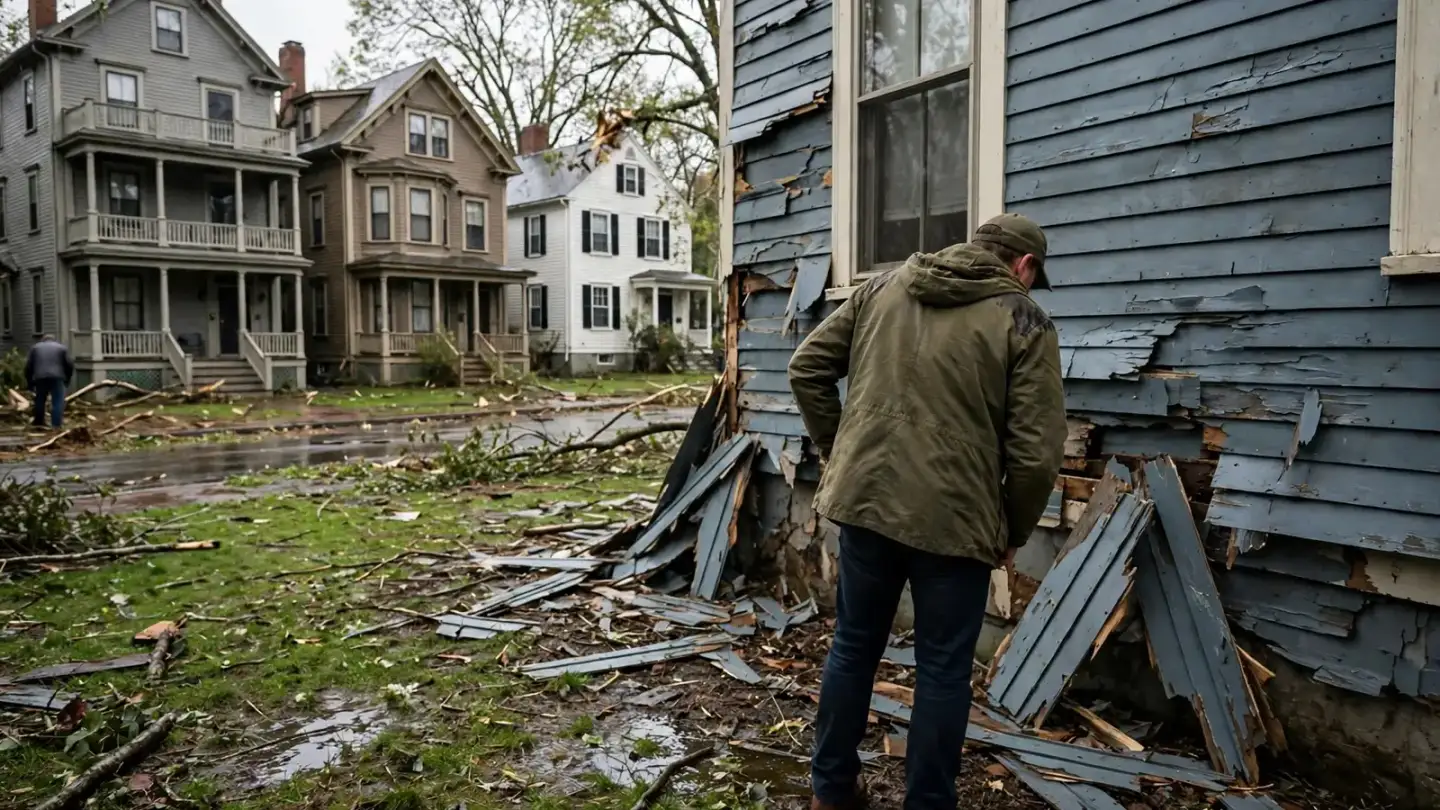
Wind damage usually shows as panels that have unlocked, lifted, cracked along the nail line or blown away entirely. Corner posts and J-channel may pull loose. On wood clapboard, wind can pop old nails and leave boards hanging. Shingles can tear off at gables and bays.
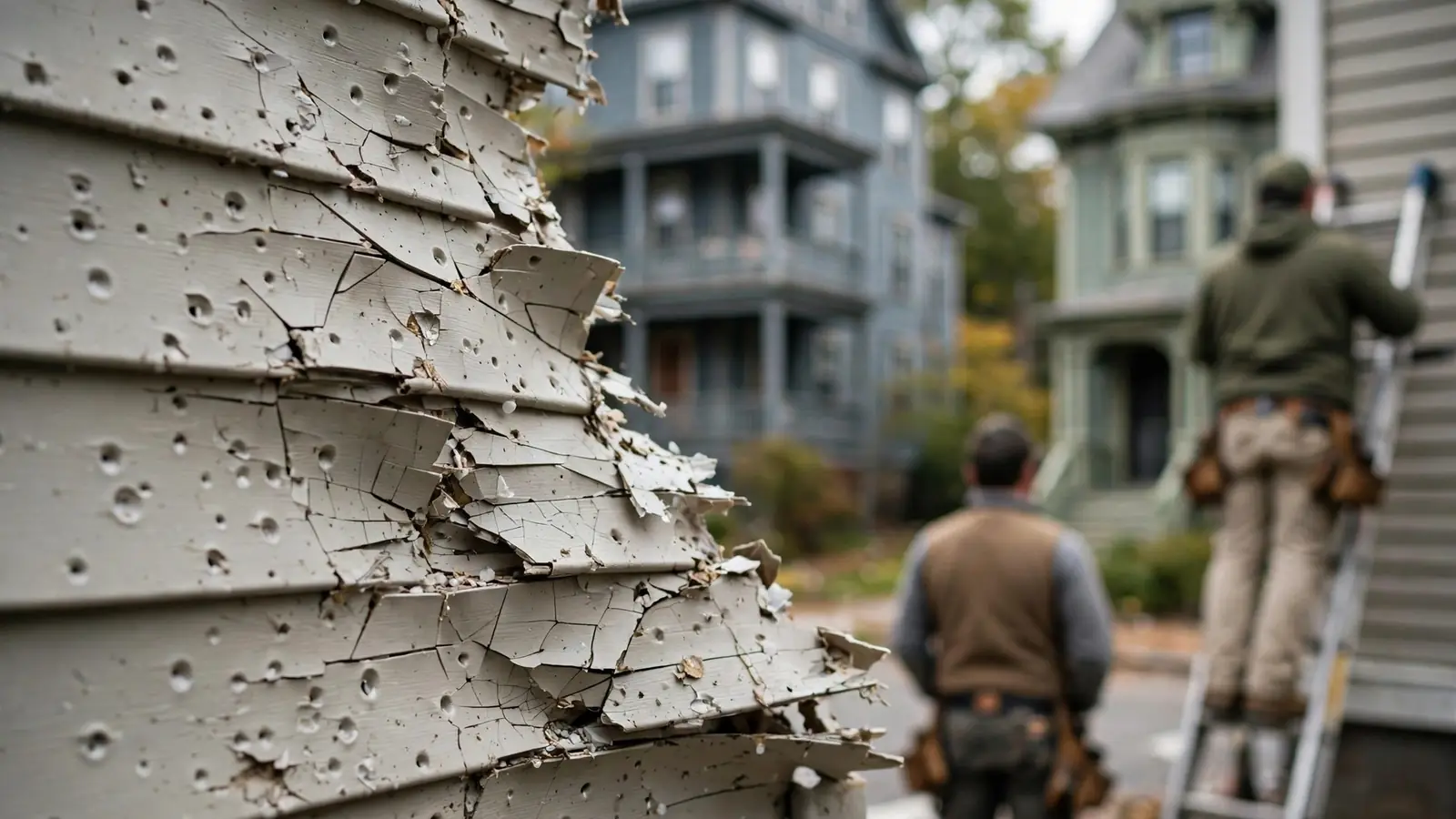
Hail damage looks different. On vinyl, it shows as cracks, punctures or dents, often concentrated on the wall facing the storm. On painted wood and fiber cement, hail may chip paint or crack boards. On aluminum, it leaves dents that do not crack but can loosen panels.
In both cases, damage behind the siding is the real concern. Torn housewrap, wet sheathing and water in wall cavities can turn a cosmetic repair into a mold problem if the wall stays wet for weeks. A good contractor will look behind damaged areas rather than just snapping new panels in.
Storm damage signs
How to spot storm damage on siding
Walk around the house once it is safe to go outside. These are the things to look for.
Missing or flapping panels
Obvious, but check the panels on either side too. They may have unlocked without falling.
Read moreCracks along nail lines
Wind flexes vinyl at the nailing hem. Fine cracks there often lead to panels tearing off in the next storm.
Dents and holes on one side
Hail hits the side facing the storm hardest. Compare walls to see the pattern.
Loose corner posts and trim
Corners pulled away from the wall leave open edges where water gets in.
Exposed housewrap or sheathing
Any exposed barrier or bare wood needs temporary cover quickly.
Water stains inside after a storm
Wet spots on interior walls or ceilings near exterior walls mean water got behind the siding.
Read more
Hail damage figure
Why storms damage siding
Why Boston storms are hard on siding
Boston sits in the path of coastal storms that bring strong northeast winds, heavy rain and wet snow. Gusts push on panels from below and create suction on walls downwind, which pulls panels outward. Panels that were nailed too tight, too loose or into thin sheathing without hitting framing are the first to go.
Cold makes it worse. In winter, vinyl becomes more brittle, so a gust that flexes a panel can crack it at the nail line. Ice and debris blown by wind add impact damage. Summer thunderstorms bring hail, which cracks vinyl easily on walls facing the storm.
Older siding fails sooner. Panels that are already chalky, thin or loosely locked have less strength left. Many storm damage calls in Boston involve siding that was already near the end of its life, which affects whether repair or replacement makes more sense.
Location matters too. Houses on hills, at street ends or along the harbor in South Boston, East Boston and Dorchester's coastal edges catch more wind than houses sheltered by neighbors.
Storm repair steps
How contractors handle storm-damaged siding
- 1
Make it safe
Loose panels or trim that could fall are removed or secured, and any downed wires are left for the utility.
- 2
Protect the wall
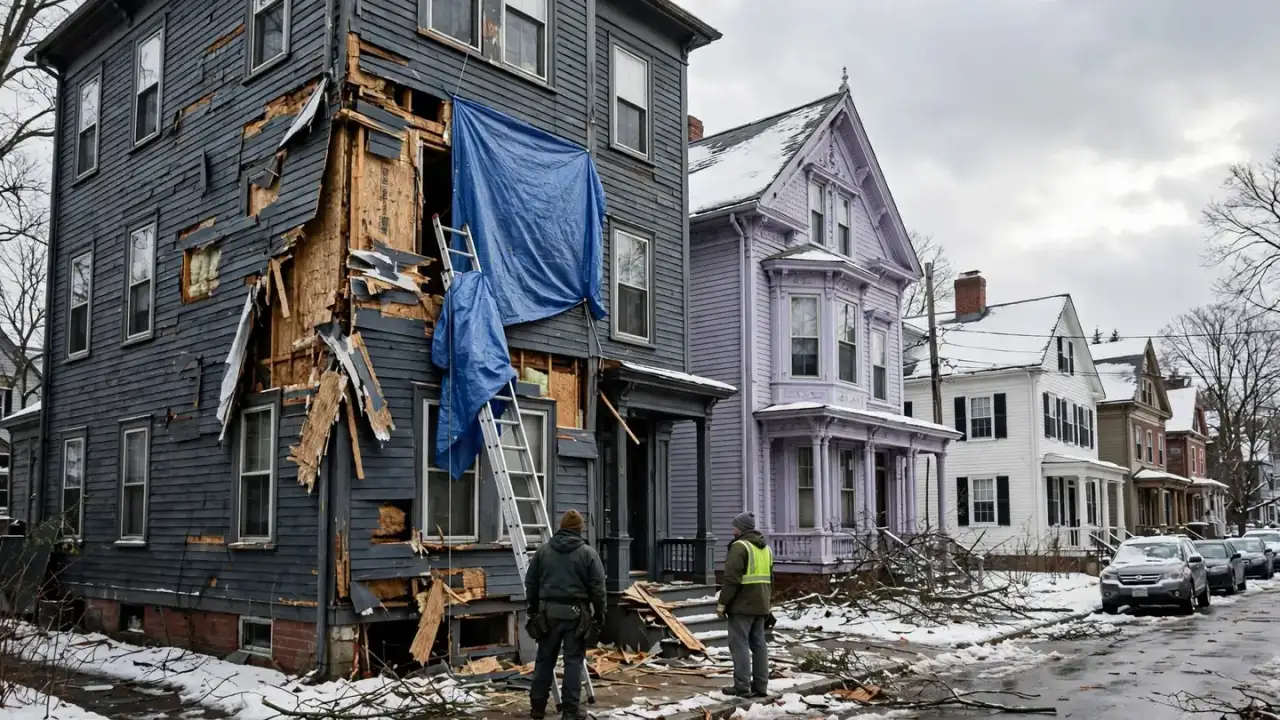
Exposed housewrap or sheathing is covered with temporary wrap, tape or tarps secured to shed water.
- 3
Document
Photos are taken of each damaged area, wide and close, before anything is removed.
- 4
Open and inspect
Damaged panels come off so the barrier and sheathing behind can be checked for water and tears.
- 5
Dry and repair
Wet sheathing is dried or replaced, and torn housewrap is patched and lapped properly.
- 6
Replace siding
New panels or boards are installed with correct nailing, matched as closely as possible to the existing wall.
- 7
Review the rest of the house
Other walls are checked for loosened panels or hidden cracks that could fail in the next storm.
Storm damage by material
How storms affect different siding materials
| Material | Wind damage | Hail damage | Usual repair |
|---|---|---|---|
| Vinyl | Unlocked or blown-off panels, cracks at nail hem | Cracks, holes, especially in cold | Replace panels, re-nail correctly |
| Wood clapboard | Boards loosened, nails popped | Paint chipping, dents in softwood | Re-nail, splice boards, repaint |
| Cedar shingles | Shingles torn off at edges and gables | Splits and chips | Weave in new shingles |
| Fiber cement | Rarely torn off; trim may loosen | Usually resists; heavy hail may crack | Replace cracked boards, repaint |
| Aluminum | Panels loosen or crease | Dents | Replace sections if available, otherwise re-side wall |
After a storm
What to do yourself after a storm hits
Do these only when it is safe and the storm has passed.
- Stay clear of downed power lines and report them to the utility immediately.
- Photograph every damaged wall from a distance and up close, with the date.
- Collect blown-off panels if you can do so safely; they help match color and profile.
- Cover small exposed areas you can reach from the ground with plastic sheeting and tape.
- Check inside for water stains, wet insulation or damp spots near outside walls.
- Contact your insurer to ask about their claim process before permanent repairs.
- Do not climb ladders in wind, ice or rain to reach upper stories.
Storm work limits
Storm damage tasks to leave to a contractor
Upper-story storm damage is a job for a contractor with staging or proper ladders and fall protection, not for a homeowner after a storm when surfaces are wet and winds may still be gusting. Anything involving electrical service lines, meter bases or damaged chimneys should be handled by the right professionals and the utility.
If water has reached insulation or interior walls, a contractor should open the wall and dry it out. Wet insulation and sheathing left in place can lead to mold within days in warm weather.
Storm damage siding in Boston: local specifics
Storm conditions in Boston neighborhoods
Coastal neighborhoods take the brunt of many storms. In South Boston near City Point, East Boston along the harbor and Dorchester near Savin Hill and Neponset, wind comes off open water with little to slow it down. Houses there tend to see more wind damage, and salt spray can speed up corrosion of fasteners and aluminum trim.
Inland neighborhoods are not immune. Hilltop streets in Roxbury, Jamaica Plain and Roslindale catch strong gusts, and tall triple-deckers stand above surrounding trees. Trees themselves are a hazard: falling limbs damage siding, gutters and trim during storms, especially in tree-lined neighborhoods like Jamaica Plain and West Roxbury.
After major storms, demand for contractors rises across the region. Temporary protection buys time, and calling early helps. Permanent siding replacement in Boston still requires the city's Short-Form permit, and historic districts still require Landmarks Commission approval for visible changes, even after storm damage. [4]
Be cautious with anyone going door to door after a storm. In Massachusetts, check that a contractor is registered as a Home Improvement Contractor for work on owner-occupied homes, get a written contract, and avoid paying large sums before work begins.
Storm repair or re-side
Storm repair versus full replacement
| Situation | Repair | Re-side |
|---|---|---|
| A few panels lost on one wall | Usually repair | Not needed |
| Hail damage across one whole elevation | Replace that wall | If matching panels are not available |
| Damage on several sides, old siding | Possible but patchy | Often the better long-term choice |
| Wet sheathing in many places | Repair after drying | If damage is widespread |
| Panels discontinued and faded | Patch may look obvious | Re-siding gives a consistent look |
Insurance and documentation
Documenting siding storm damage for insurance
Homeowners insurance often covers sudden storm damage, subject to the policy and deductible. Whether it does is between you and your insurer, but good documentation helps any claim. Take photos before cleanup, keep any pieces that blew off, note the date and time of the storm and save receipts for temporary protection.
A contractor can describe what they find, but they cannot decide your claim. Be wary of anyone who promises the insurer will pay for a full replacement or offers to handle the claim for you in exchange for signing a contract on the spot. Read your policy and talk to your insurer directly.
Matching is a common issue in claims. If the damaged siding is discontinued or faded, a repair may not match. Ask your insurer how the policy handles matching before work begins.
Preparing for the next storm
Preparing siding for the next storm
After repairs, use the calm to strengthen the rest of the house. Have loose panels on other walls clipped back in. Check that corner posts and trim are fastened. Trim back tree limbs that overhang the house. Make sure gutters are secure and clear, because a loose gutter can tear off and take siding with it.
If your siding is old and brittle, consider whether replacing it before the next storm season would save repeated repairs. Thicker vinyl panels with good wind ratings or fiber cement may hold up better in exposed spots. Ask the contractor what the wind rating of a product means and how installation affects it.
Ice, snow and storm damage
Winter storm damage that shows up later
Not all storm damage is visible right away. Heavy wet snow sliding off a roof can bend gutters and push down on the top of siding. Ice dams at the eaves can force meltwater behind the top course for weeks after a storm. Snow drifted against walls can keep the bottom courses wet until spring.
In early spring, walk the house again. Look for panels that have dropped, trim that has pulled away, and stains below the eaves. Problems caught then can be fixed before the summer storm season begins.
Temporary protection
Covering a damaged wall until permanent repairs
Temporary protection is about keeping water off the sheathing and out of the wall cavity until the permanent repair can be done. On small areas within reach from the ground, a sheet of heavy plastic or a scrap of housewrap, lapped so the top edge tucks under any intact siding above and taped or battened in place, will shed rain for a while. The key is direction: water should run over the patch, not behind it.
Larger or higher areas are a job for a contractor. They may install a temporary wrap over the whole damaged section, secure tarps with wood battens rather than nails through the tarp, or even reinstall salvaged panels loosely to shed water. Tarps flapping in the wind can cause more damage, so they must be fastened well.
Keep an eye on temporary protection through the next storm. Check that it has not torn or shifted and that water is not collecting behind it. Temporary protection buys days or weeks, not seasons.
Trees and debris
Tree limbs, flying debris and siding damage
In Boston's tree-lined neighborhoods, many storm damage calls start with a falling limb rather than wind on the siding itself. A heavy branch can crack panels, rip off gutters, crush trim and puncture sheathing. If a limb is still resting on the house or tangled in service wires, leave it for a tree service and the utility. Do not pull it off yourself.
Once the limb is removed, the contractor will check the full impact zone, not just the visible hole. Impact can crack panels several feet away, loosen corner posts and bend window trim. It can also damage the roof edge, which should be checked at the same time.
Flying debris is the other culprit. Trash cans, patio furniture and loose items from neighboring yards become projectiles in strong wind. Before a forecast storm, secure what you can and ask neighbors to do the same, especially on tightly packed streets where houses are only a few feet apart.
Storm damage and older layers
When storm damage exposes old siding layers
On many Boston houses, a torn-off vinyl panel reveals another surface underneath: aluminum, asbestos-cement shingles or original painted clapboard. That changes how the repair is done. If the exposed layer is old painted wood, paid work must follow lead-safe practices. If it is asbestos-cement shingle, it should not be broken, sanded or removed except by a licensed abatement contractor.
The contractor may recommend leaving the old layer in place and patching the outer layer, or treating the damage as a reason to strip the wall and re-side it properly. That decision depends on how much of the house is damaged, the condition of the layers and your plans for the house. The upside of storm damage, if there is one, is that it reveals the wall's condition and lets you make an informed choice.
Choosing a contractor after a storm
Choosing a siding contractor after a storm
After a big storm, many people knock on doors and leave flyers. Some are good local contractors, and some are not. Take a breath before signing anything. In Massachusetts, check the contractor's Home Improvement Contractor registration on the state's Contractor Hub. Ask for a written contract that describes the work, the materials, the timeline and the permit, and avoid large payments before materials arrive.
Ask how they will protect the house in the meantime, whether they will open the wall to check for water, and how they will match existing siding. Ask who handles the Short-Form permit and whether the house sits in a historic district. A contractor who answers these questions clearly is usually a safer choice than one who pushes for a quick signature.
Storm damage on bays and gables
Damage at gables, bays and upper stories
The highest and most exposed parts of a house take the strongest wind. Gable ends, the tops of bays and the third story of a triple-decker often lose siding or shingles first. Those areas are also the hardest to inspect from the ground, so damage can go unnoticed until stains appear inside. Binoculars help. Look for missing shingles in gable patterns, panels that sit out of line near the eaves and trim that has pulled away at the top of bays.
Repairs up there need staging or lifts and should be planned with safety in mind. If the roof edge was also damaged, coordinate the siding and roofing work so the flashing between them is restored correctly.
Storm damage siding questions
Questions about storm-damaged siding in Boston
What should I do right after siding blows off?
Stay safe first. Then photograph the damage, cover any exposed sheathing you can reach from the ground, check inside for water and call a contractor to secure and assess the wall.
Can missing siding wait until spring?
It is risky. Exposed housewrap and sheathing take on water from rain and snow, which can rot wood and grow mold. At minimum, get the area covered with temporary protection quickly.
Does homeowners insurance cover siding storm damage?
Often, for sudden wind or hail damage, depending on your policy and deductible. Document the damage and talk to your insurer before permanent repairs. A contractor cannot decide your claim.
How can I tell if hail damaged my siding?
Look for cracks, holes and dents on the wall that faced the storm, and compare with other walls. Hail damage on vinyl is often easier to spot in low-angle light.
Why did only some of my panels blow off?
Wind loads vary across a wall, and panels with weak nailing or older, brittle material fail first. Corners and the tops of walls usually see the strongest suction.
Do I need a permit to repair storm-damaged siding in Boston?
Siding replacement falls under Boston's Short-Form permit. Temporary protection does not. Historic districts still need Landmarks Commission approval for visible changes.
Should I hire a contractor who knocks on my door after a storm?
Be cautious. Check their Massachusetts Home Improvement Contractor registration, get a written contract and avoid large upfront payments. Calling a contractor yourself gives you more control.
Can a contractor match my old siding after storm damage?
Often closely, but discontinued or faded panels are hard to match exactly. Contractors may move panels between walls or replace a full wall section to keep the look consistent.
How soon after a storm should siding be repaired?
Exposed areas should be covered within a day or two. Permanent repairs can follow once the wall has been checked and dried, ideally before the next significant rain or snow.
Can wind damage siding I cannot see from the ground?
Yes. Upper courses and gables can lose shingles or panels that are hard to see. Binoculars help, and a contractor with ladders or staging can check closely.
Is storm damage worse on older vinyl?
Usually. Older vinyl is often thinner and more brittle, so it cracks and tears more easily in wind and cold. Widespread damage on old panels often leads to a full re-side.
Should I keep the pieces of siding that blew off?
Yes, if you can collect them safely. They show the profile and color for matching and help document the damage. Store them flat in a dry place until the contractor visits.
Can storm damage loosen trim as well as siding?
Yes. Corner boards, window trim and fascia often loosen in strong wind. A contractor should check and refasten trim when repairing siding so water cannot get in behind it.